
Disclosure: this page contains no affiliate links. Some pages on this site do — they are marked, and per our affiliate disclosure they have no input into the weights or scores described below. Several of our top-rated services pay us nothing.
The protocol in one paragraph
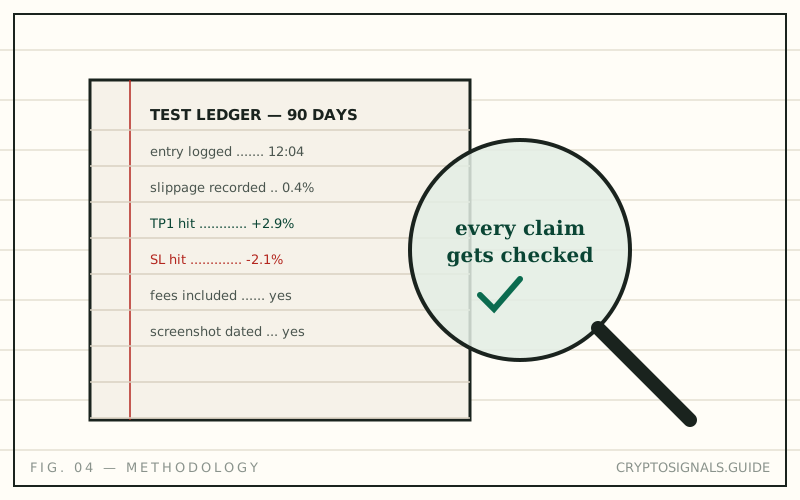
We subscribe with our own money, at the public price, without telling the provider. From the moment access opens, every published call gets logged with its timestamp — pair, direction, entry or entry zone, stop-loss, every take-profit target, and any suggested leverage. We then track what the market actually did against those levels, apply real trading costs, and score the provider after a 90-day window. No provider sees a draft. No provider can pay to change a number.
That's the whole trick. It isn't clever — it's just work that a rewritten sales page can't fake. The output feeds our accuracy tracker and the scorecard on each of the 51 reviews.
What we log for every call
A signal only counts if it was logged before the outcome was known. For each call we record:
- Timestamp of publication — so a provider can't quietly re-date a call after the move happens.
- Entry price or entry zone — zones get logged at their worst fillable edge, not the flattering one.
- Stop-loss — a call published without one is recorded as a defect, not "flexible risk management".
- All take-profit targets — because "TP1 hit = win" bookkeeping is the single most common way win rates get inflated.
- Edits and deletions — if a losing call vanishes from the channel, our log keeps it, and the deletion itself gets noted in the review.
Trades are graded against a consistent rule: a call is a win only when it reaches its targets before the stop, on levels that were realistically fillable when published. A "win" that required catching a five-second wick at 3 a.m. is graded as unfillable — a category providers love and we don't.
Fees and slippage count against every trade
Published track records almost always assume free, instant, perfect fills. Real accounts pay taker fees on both sides and lose a little on entry each time a signal moves the market — which popular channels with six-figure audiences reliably do. So we deduct exchange fees and a realistic slippage allowance from every logged trade before it enters the tally.
The effect is not cosmetic. On high-frequency scalp strategies, costs can turn a marketed "profitable month" into a flat or losing one — one of the reasons tracked results in our tracker sit 10–27 percentage points below claimed figures across the niche.
Why 90-day windows
Anyone can screenshot a hot week. Ninety days is long enough to catch what marketing hides: the losing streak, the "entry zone" that quietly widens after the fact, the week the admin stops posting when the market turns. Depending on signal frequency, a window covers roughly 50–300 calls — a sample where luck starts to wash out and habits show.
Windows also keep old glory from subsidizing current sloppiness. A provider that was sharp in 2023 and lazy now gets scored on now. When we re-test a service, the review's "Updated" date reflects it.
Score weights: how a number out of 10 gets built
Every score on this site is assembled from five fixed components. The weights don't move per provider, and they're deliberately tilted toward what can be verified:
| Component | Weight | What we're asking |
|---|---|---|
| Verified performance | 35% | What did the logged calls actually return after costs — not what the ads say? |
| Transparency | 25% | Is there a public, loss-inclusive track record? Do losing calls survive in the channel? |
| Pricing & value | 15% | Is the fee defensible against tracked results and against cheaper alternatives? |
| Risk practices | 15% | Stops on every call, sane leverage suggestions, honest drawdown talk. |
| Support & UX | 10% | Billing that works, cancellation that works, admins who answer. |
Two consequences of this design are worth spelling out. First, a mediocre-but-honest desk beats a flashy-but-unverifiable one: 25% of the score is transparency, and an unauditable "96% win rate" earns close to zero there. Second, infrastructure that makes no performance claims at all — execution bots, exchange copy trading — can score well on the strength of verifiable pricing and risk controls, which is why tools sit near the top of our rankings.
When we can't subscribe at all
Some services in our directory can't be tested the normal way: the domain is parked, the "product" exists only in press releases, or the operator vanishes between our research passes. We don't pad those pages into fake reviews. The review says, in plain words, that the service could not be verified — and the score reflects the absence of evidence.
Absence of evidence isn't neutral in this niche. A brand generating search demand with no confirmable product behind it is a specific, known pattern, and it's documented with examples in our scam warning hub. If you want to run the same checks yourself before paying anyone, our provider vetting checklist is the self-service version of this protocol.
What our numbers can't tell you
Honesty cuts both ways, so here are the limits. We track published calls — if a provider runs a private tier we haven't bought, that tier isn't in our data and the review says so. Slippage is modeled, not measured on your account, and your fills on a fast scalp will differ from our assumptions. And a 90-day window, however honest, is still a sample: it can't promise the next 90 days, which is why every page on this site carries the same risk warning you'll find below.
What the numbers can do is falsify marketing. When a channel claims 92% and a full count of its own published calls produces 77.8%, that gap is real information — the kind this site exists to publish.
Methodology FAQ
Do you really pay for the subscriptions you review?
Yes, at the public price, from our own budget. Providers aren't told they're being tracked, and none see a review or score before publication.
Why 90 days and not longer or shorter?
Shorter windows flatter whoever got lucky that month. Ninety days covers roughly 50–300 calls depending on frequency — enough for losing streaks and post-editing habits to surface. We'd rather re-test periodically than let one ancient result stand forever.
What exactly counts as a "win" in your log?
The call reached its target(s) before its stop, at levels realistically fillable when published, with fees and slippage deducted. Wick-only touches and retroactively widened entry zones don't count.
What if a service can't be subscribed to?
The review says so openly — no padding, no invented experience. Unverifiable services are scored on the evidence that exists, which is usually not much, and the worst patterns are cross-referenced in our scam hub.
Can a provider pay for a better score?
No. Weights are fixed and public, affiliate relationships are disclosed per our disclosure policy, and several top-rated services pay us nothing while some flagged high-risk services run the richest affiliate programs in the niche. If money moved scores, our rankings would look very different.
Crypto assets are volatile and largely unregulated. Signal services — including every service mentioned on this page — can and do post losing streaks. Never trade with money you cannot afford to lose, and never treat a paid subscription as a guarantee of profit.
We test crypto signal providers with real subscriptions and log every published call — entries, stops and targets — before scoring anyone. Read how we test →