
Affiliate disclosure: some links on this page are affiliate links — if you sign up through them we may earn a commission at no extra cost to you. This never affects scores: ranking criteria are set out in our testing methodology, and several top-rated services here pay us nothing.
How signal-to-bot execution actually works
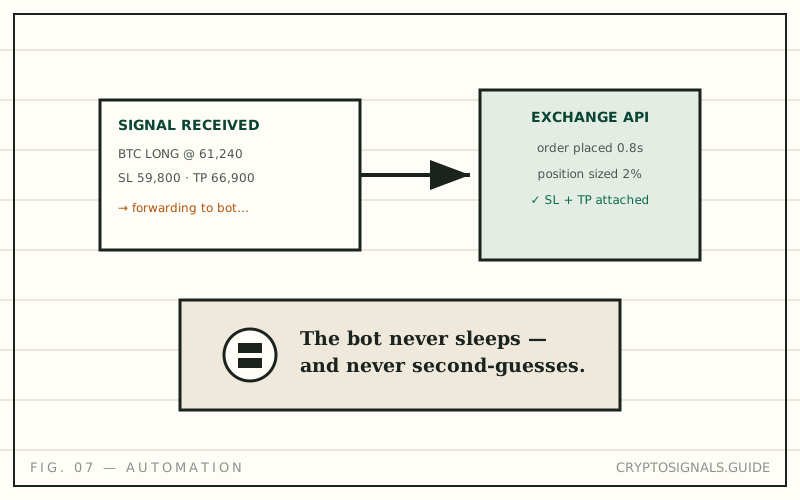
The chain has four links. A provider posts a call — pair, direction, entry zone, take-profit ladder, stop-loss. The bot parses that text (or receives a TradingView webhook). Your pre-configured rules translate it into an order: which exchange, what percentage of the account, what leverage cap. The exchange executes via API keys you created — keys that can trade but, if you set them up correctly, can never withdraw.
That last sentence is the entire security model of this category. The bot never holds your coins. It holds permission to trade them. Everything in this ranking flows from how well each tool manages that permission — and how hard it lets you cap the damage when a signal provider has a bad week. And they all have bad weeks: the tracked-vs-claimed numbers in our accuracy tracker make that plain.
The ranking: eight automation tools compared
Scores follow our standard rubric — for SaaS tools the weight sits on transparency, risk controls and value rather than win rates, since a bot has no win rate of its own. Prices are the cheapest paid tier as of this update (July 2026).
| # | Tool | Type | From | Standout fact | Score |
|---|---|---|---|---|---|
| 1 | Cornix | Telegram signal executor | $32.99/mo | Parses most paid groups' calls natively; 11 exchanges | 8.2 |
| 2 | Bitsgap | Bot platform | $23/mo | Grid/DCA/COMBO bots, backtests up to 365 days, 17+ exchanges | 7.8 |
| 3 | 3Commas | Bot platform | $20/mo | Signal Bots + DCA/Grid; survived and disclosed its 2022 API breach | 7.4 |
| 4 | Pionex | Exchange with built-in bots | Free bots | 16 bots at 0.05% trading fee — no subscription at all | 7.3 |
| 5 | Cryptohopper | Bot + signal marketplace | $24.16/mo | Oldest marketplace; strategy sellers of wildly uneven quality | 7.2 |
| 6 | Coinrule | No-code rule builder | $719/yr | If-this-then-that automation pitched at beginners — priced like pro software | 6.8 |
| 7 | Altrady | Trading terminal + signal bot | €28/mo | Multi-exchange terminal, 5-day trial, 30-day refund window | 6.8 |
| 8 | WunderTrading | Bot platform | Free tier | TradingView-webhook automation; also runs its own review blog | 6.7 |
Each tool in 100 words
Cornix — 8.2
Cornix is the infrastructure layer under most paid Telegram groups: providers format calls specifically so Cornix can parse entry zones, laddered take-profits and stops without human help. It connects to 11 exchanges, and its client-side risk settings — fixed position size, max concurrent trades, leverage caps — are the best implementation of the "protect me from my provider" idea we've tested. Advanced runs $32.99/month, Premium $52.99, community-admin plans from $146.90 as of this update. If your signals arrive on Telegram, this is the default choice. Full breakdown: Cornix review.
Bitsgap — 7.8
Bitsgap approaches automation from the strategy side rather than the signal side: Grid, DCA and COMBO bots you configure yourself, plus an AI assistant and backtesting up to 365 days on 17+ exchanges. That backtest is the honest part — you can watch a configuration lose money on historical data before it loses yours. Plans run Free, then $23, $55 and $119 per month as of July 2026. Weak spot: it isn't built to parse third-party Telegram calls, so it suits self-directed traders more than group followers. Details: Bitsgap review.
3Commas — 7.4
The biggest name in the category, with Signal Bots, DCA/Grid automation and a provider marketplace, from $20/month (Pro $50, Expert $140). The 2022 API-key incident — covered below — costs it points on trust, but its response set the disclosure standard the rest of the niche still hasn't matched. Deep feature set, occasionally cluttered interface, solid exchange coverage. If you want one platform to do signals, DCA and grid work at mid-market pricing, it's the pragmatic pick. The incident and what changed since: 3Commas review.
Pionex — 7.3
Pionex flips the model: it's an exchange with 16 bots built in, free, monetized through 0.05% trading fees. No subscription, no API keys to a third party — the bot and the order book live in the same house, which removes an entire attack surface. The trade-off is lock-in: its bots trade only on Pionex, and the strategy set (grid, DCA and variants) is narrower than a dedicated platform's. As an argument that automation shouldn't cost $50/month, it's compelling. Full take: Pionex review.
Cryptohopper — 7.2
One of the oldest platforms in the niche, from $24.16/month (Adventurer $57.50, Hero $107.50), with AI strategy tools, Copy Bot and the category's largest strategy marketplace at $9.99–99.99/month per strategy. The marketplace is both the sales pitch and the problem: seller quality varies enormously, and the platform profits from volume, not from your results. We treat every marketplace listing as an unverified signal provider that happens to live inside an app — vetting rules below. Full analysis: Cryptohopper review.
Coinrule — 6.8
Coinrule is a no-code rule builder: "if BTC drops 3% in an hour, buy $200" assembled from templates, with TradingView-alert triggers. As a learning tool for automation logic it's genuinely well designed. The bill is the issue: Trader costs $719/year and Pro $5,399/year as of this update — decidedly pro pricing for a product positioned at beginners. Run the math on your account size before subscribing; a $719 tool needs a big base to justify itself. Numbers and alternatives: Coinrule review.
Altrady — 6.8
Altrady is a multi-exchange trading terminal with a signal bot bolted on — closer to a professional cockpit than a set-and-forget robot. TradingView webhooks, portfolio analytics, and consumer-friendly terms that deserve mention: a 5-day trial and a 30-day refund window, rare in this niche. Pricing runs €28 to €90 per month as of July 2026. Best fit: active traders who want automation inside a manual workflow rather than instead of one. Full review: Altrady review.
WunderTrading — 6.7
WunderTrading's core competence is turning TradingView alerts into live orders — one bot on the free tier, scaling up through paid plans (up to 25% off annually; the company doesn't publish a simple price list, which we count against it). It also runs its own reviews-and-rankings blog covering competitors, an altFINS-style dual role worth knowing about when you read its content. Solid webhook automation, middling transparency. Where it fits and where it doesn't: WunderTrading review.
Position-size caps: the one feature that actually saves accounts
Marketing pages sell AI and backtests. What keeps accounts alive is duller: a hard cap on how much any single signal can commit. Signal providers routinely suggest 5–20x leverage and "5–10% per trade" — sizing that turns a normal losing streak into a wipeout.
Concrete case. Account: $5,000. A group fires four losing calls in a week — unremarkable, per our tracking data. At the provider's suggested 10% per trade with 10x leverage, each stopped call losing 3% from entry costs 30% of its margin: $150 per trade, $600 for the week, and that's the friendly scenario where every stop actually fills. With a bot enforcing 2% positions, the same week costs $120 total. Same signals, same market — the only difference is a number you typed into a settings screen once.
This is why an executor with strict client-side caps outranks flashier platforms here, and why "does it let me cap size, leverage and concurrent trades?" should be your first filter question. The arithmetic in full, with the position-size formula: how to use crypto trading signals.
Marketplace strategies: the quality lottery
Cryptohopper's marketplace — and 3Commas' provider ecosystem — lets anyone sell a strategy or signal stream for $9.99–99.99/month. Some sellers are competent. Others are curve-fit backtests with a logo. The platform takes its cut either way, which means the marketplace's incentive is listings volume, not your equity curve.
Treat a marketplace seller exactly like an unknown Telegram channel: demand a track record that includes losing periods, check whether results are backtested or live, start with the minimum position size, and log the first month of trades yourself before scaling. The same 10-point vetting checklist we apply to signal groups works unchanged: how to vet a provider.
The 3Commas lesson: API keys are real money
In late 2022, 3Commas confirmed that a large set of customer exchange API keys had leaked, and attackers used them to place manipulative trades through victims' accounts. Users lost real funds without a single coin ever sitting on 3Commas itself — the keys were enough.
Three permanent rules fell out of that incident, and they apply to every tool on this page, not just 3Commas:
- Trade-only keys, always. Withdrawal permission stays off. Any service that requests it has disqualified itself.
- IP whitelisting where offered. A stolen key that only works from the platform's servers is a much smaller prize.
- Keys are perishable. Rotate them on a schedule and revoke them the day you stop using a service — dead subscriptions with live keys are how old breaches bite years later.
Even a well-run platform is a honeypot: thousands of trade-enabled keys in one database. Size the trust you extend accordingly — connect one exchange account with a defined bankroll, not your main stack.
How to choose (60-second version)
- Your signals arrive on Telegram → Cornix. It's what the groups themselves assume you're running.
- You build strategies, not follow callers → Bitsgap for grid/DCA with real backtests, or 3Commas for the broadest toolset.
- You refuse to pay a subscription → Pionex: free bots, exchange-native, 0.05% fees.
- You automate TradingView alerts → WunderTrading or Altrady.
- You're not sure bots are the right category at all → read signals vs copy trading vs bots first; copy trading may fit better.
Whichever you pick, the bot only executes. The quality of what it executes comes from your signal source — so choose that with at least as much care, starting from our main ranking or the Telegram channel list.
Red flags in the auto-trading niche
- "Fully automated profit" marketing. A bot has no edge of its own. Anyone selling automation as a return stream is selling the HYIP pattern with extra steps — see the taxonomy in our scam hub.
- Withdrawal-enabled API requests. No legitimate automation product needs them. None.
- Backtests without live results. Overfitting historical data is a few clicks of work; surviving three live months isn't.
- Locked-in "profit sharing" deposits. Real bot platforms bill a subscription against your own exchange account. Products that hold your deposit and pay "yield" are a different — and worse — business.
Signal bot FAQ
What is a crypto signal bot?
Software that reads a trading signal — from a Telegram group, a TradingView alert or a marketplace strategy — and places the matching orders on your exchange account via API keys. You keep custody; the bot only gets trading permission.
Can a signal bot withdraw my funds?
Not if you set the keys up correctly: trading permission on, withdrawal permission off, IP whitelist enabled where the exchange supports it. Any tool that asks for withdrawal rights should be closed immediately.
Which bot works best with Telegram signal groups?
Cornix — most paid groups format their calls for it deliberately. For TradingView-webhook automation, 3Commas, WunderTrading and Altrady are the stronger fits.
Do trading bots make automatic profit?
No. Bots execute faster and more consistently than humans — including losing strategies. Automation fixes execution discipline; the win rate still comes entirely from the signal source. Check what tracked win rates really look like in the accuracy tracker.
How much does auto-trading cost in total?
As of July 2026, platform fees run $20–$33/month at entry tiers (Pionex: free bots, 0.05% trade fee). Add the signal group's own subscription — commonly $40–$370/month per our price comparison — plus exchange trading fees. Automation is the cheap line item.
Crypto assets are volatile and largely unregulated. Signal services — including every service mentioned on this page — can and do post losing streaks. Never trade with money you cannot afford to lose, and never treat a paid subscription as a guarantee of profit.
We test crypto signal providers with real subscriptions and log every published call — entries, stops and targets — before scoring anyone. Read how we test →