
Disclosure: this guide names no providers and ranks nothing. The one sponsored banner below is labeled. Sitewide, some links are affiliate links — the firewall between them and our scores is described in how we test.
Why vetting beats picking
Asking "which signal provider is best?" invites someone else's affiliate link as an answer. Asking "how would I catch this provider lying?" gives you a skill that works on every channel, forever. The economics force the issue: a Telegram channel costs nothing to start, claims cost nothing to type, and the audience churns fast enough that a channel can blow up accounts for a year and keep growing.
The good news is that verification is cheap. Trades happen at public prices — anyone with the patience to write down calls and check them against a chart can audit any channel on earth. Providers survive on the fact that almost nobody does.
The 10-point self-audit checklist
Put these questions to any provider before money moves. Score one point per clean answer:
- Is the published history loss-inclusive? Scroll back three months. If you can't find a single losing call, you're reading advertising, not a track record.
- Are timestamps tamper-proof? Telegram shows edits; dashboards may not. A history that can be rewritten after the fact proves nothing.
- Can wins be cherry-picked from entry zones? If entry "zones" are wide and results are always measured from the favorable edge, the accounting is rigged by design.
- Has the win rate survived an independent count? Self-reported numbers routinely shrink 10–27 points when a third party counts. Check ours and others' before believing anyone's.
- Is risk-reward disclosed per trade? A provider that reports hit rate but never average R:R is hiding half the equation — the half that decides profitability.
- Is the team identifiable? Not necessarily doxxed — but an operation with zero accountable humans has zero cost to exit-scamming you.
- Are returns ever "guaranteed"? One appearance of guaranteed profit, loss compensation or "risk-free" ends the audit (see disqualifiers below).
- Any pump language? "Insider info", "next 10x gem, VIP gets in first" — that's a coordinated pump funnel describing itself.
- Are there clone channels — and does the provider fight them? Big names attract impersonators; honest operators warn about them loudly. Silence is telling.
- Are refund and cancellation terms written down? Vague "contact admin" refund policies correlate strongly with the billing complaints we log in reviews.
Eight or more: worth a paper audit. Five to seven: audit only if something specific attracts you. Below five: close the tab. For calibration, the same standards applied to real services — with scores — live in our review index.
Instant disqualifiers
Three of the ten aren't points to tally — they're ejector seats. Guaranteed returns, insider/pump access, and loss compensation schemes each mark a business model that needs your deposit more than your subscription. The taxonomy of what each scheme does to its subscribers — pump funnels, clone channels, HYIP-style "AI compounding" — is documented with examples in the scam-warning hub. If you hit one of these, don't finish the checklist. There's nothing left to learn.
The 30-day paper audit
The checklist filters liars; the paper audit measures the survivors. The method our desk uses, scaled down to one person and zero dollars:
- Pick the feed. The provider's free channel, or a trial tier if one exists. Turn on notifications — you're logging calls as they arrive, not from memory.
- Log within minutes of publication. Copy every field verbatim: pair, direction, entry, stop, all targets, leverage. Note the exact time you saw it — that's the entry you could realistically have had.
- Grade only resolved trades. A trade resolves when it hits the stop, the final target, or your patience limit (we use 14 days). Open trades are neither wins nor losses — counting them early is exactly the trick providers use.
- Never skip a call. The temptation is to ignore the obviously bad ones. Log them — the obviously bad ones are the data.
- Run 30 days minimum. Fewer than ~20 resolved trades tells you almost nothing; one hot week proves even less.
The tracking spreadsheet, worked through
One row per signal. The columns that matter: Date seen · Pair · Direction · Entry · SL · TP1…TPn · Leverage · Levels hit · Exit price · Result (R). Here's a hypothetical three-row sample with the arithmetic done:
| Seen | Pair | Entry | SL | TPs | Outcome | Result |
|---|---|---|---|---|---|---|
| Jul 02, 14:10 | BTC/USDT long | 64,500 | 62,700 | 66,300 / 67,600 | TP1 hit, rest stopped at breakeven | +0.5R |
| Jul 03, 09:45 | SOL/USDT long | 140 | 131 | 146 / 150 / 156 | Stopped out | −1.0R |
| Jul 05, 21:30 | ETH/USDT short | 2,520 | 2,610 | 2,430 / 2,340 | Both TPs hit | +1.5R |
The Result column is where analysis happens. Row 1: TP1 sat 1,800 above entry with an 1,800-point stop — the half position closed there earned 0.5R, the rest exited flat. Row 2 is a clean −1R. Row 3: with a 90-point stop, targets at 90 and 180 points closed half each: (0.5 × 1R) + (0.5 × 2R) = +1.5R. Sum after three trades: +1.0R across 3 trades, a 67% win rate, average win +1.0R, average loss −1.0R. Thirty days of rows like these and you can compute the provider's true expectancy — the reading skills for zones, ladders and breakeven rules are in how to read crypto signals.
Turning the log into a verdict
After 30 days, compute three numbers: win rate (wins ÷ resolved trades), expectancy per trade (average R across all rows), and the gap between your counted win rate and whatever the channel advertises. Then decide like an auditor, not a fan:
- Positive expectancy, small claim gap: the provider is a candidate — for a small, strictly-sized trial, not for your savings.
- Positive expectancy, large claim gap: the calls have value; the marketing lies. Price the service on your numbers and stay alert.
- Negative expectancy: done. No discount, no "better month coming" — your own count outranks every testimonial.
- Deleted or edited calls mid-audit: the strongest finding of all. Publish it somewhere if you can; you just did the whole industry a favor.
Cross-check your figures against our accuracy tracker where the provider appears — and if the fee-versus-account-size math still doesn't clear, the arithmetic in are crypto signals worth it settles the question.
Frequently asked questions
How do I know if a crypto signal provider is legit?
Run the audit: does it publish a loss-inclusive history, are timestamps un-editable, is the win rate independently counted, is risk-reward disclosed, is the team identifiable, are refund terms written down? A legitimate provider survives all six; most channels fail by question two.
How long should I track a signal channel before paying?
At least 30 days of paper-tracking every published call — enough to catch a losing streak and to compare the channel's claimed results against your own count. If the channel deletes or edits calls during that window, the audit is over: that behavior is the finding.
What should a signal tracking spreadsheet contain?
One row per signal: date and time seen, pair, direction, entry zone, stop-loss, every take-profit, leverage, then the outcome fields you fill in later — which levels hit, exit price, result in R. From those columns you can compute win rate and expectancy yourself.
What is the biggest red flag in a signal provider?
Guaranteed returns. No honest trading operation guarantees profit, compensates losses or sells insider pump access. Any one of those phrases ends the vetting process immediately — there is nothing left to audit.
Can I vet a provider using its free channel?
Partly. Free channels show format, frequency and honesty about losses, but they typically post the flattering subset of VIP calls. Treat a free-channel audit as a filter: it can disqualify a provider outright, but a pass only earns a cautious, small-size trial.
Crypto assets are volatile and largely unregulated. Signal services — including every service mentioned on this page — can and do post losing streaks. Never trade with money you cannot afford to lose, and never treat a paid subscription as a guarantee of profit.
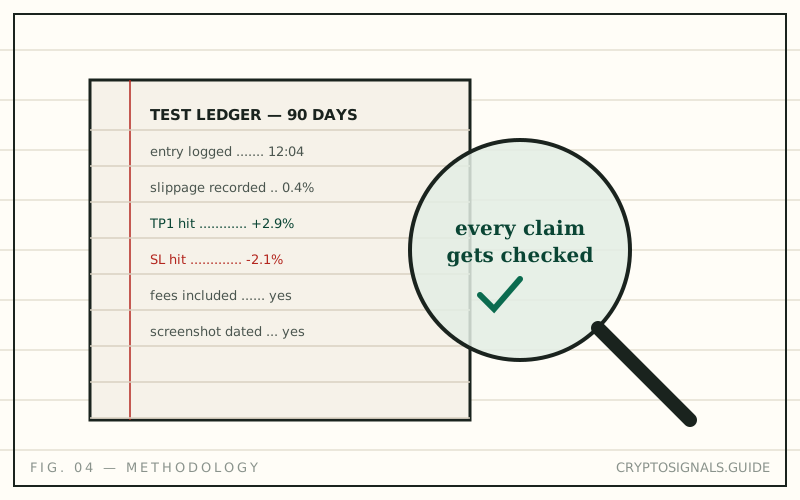
We test crypto signal providers with real subscriptions and log every published call — entries, stops and targets — before scoring anyone. Read how we test →