
Affiliate disclosure: some links on this page are affiliate links — if you sign up through them we may earn a commission at no extra cost to you. This never affects scores: ranking criteria are set out in our testing methodology, and several top-rated services here pay us nothing.
If you have a job and under $5,000 to trade, copy trading wins on arithmetic alone: no subscription, audited lead-trader stats, positions opened while you're in a meeting. If you want to choose your trades and you already know what a stop-loss is for, buy signals — and route them through an execution bot so your sizing stops being a mood. If you like rules more than opinions and trade a sideways market, run a grid or DCA bot and skip the other two entirely.
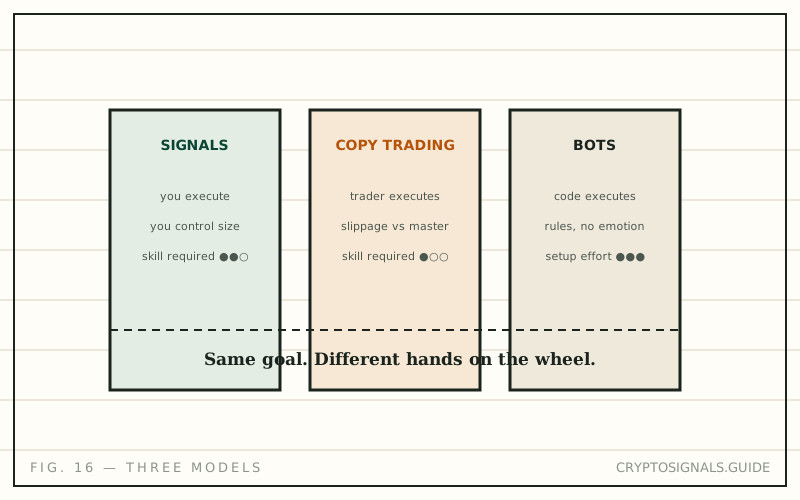
The three models, plainly
Signals. Someone publishes a trade idea — pair, direction, entry, stop, targets — and you decide whether to take it. You keep every decision: whether to enter, how much, when to bail. You also keep every mistake. Delivery is usually Telegram, sometimes Discord or an app, and pricing as of July 2026 runs from free channels to $369 a month at the top end of the provider directory.
Copy trading. You attach your account to a lead trader on an exchange, and their positions open in your account automatically at your chosen ratio. No subscription: Binance leads take 10% of your profit, Bybit masters 10–15%, and the exchange publishes each lead's history rather than the lead advertising it. The trade-off is that you can't cherry-pick — you get their whole book, including the ideas you'd have skipped.
Trading bots. You define a rule — grid, DCA, or "when this alert fires, buy this much" — and software runs it forever without getting bored or scared. Bitsgap starts at $23/month with backtests up to 365 days, 3Commas at $20, and Pionex builds 16 bots into the exchange for free. Nobody's opinion is involved, which is the whole appeal and the whole limitation.
Side by side
| Signals | Copy trading | Bots | |
|---|---|---|---|
| Who executes | You, manually | The exchange, automatically | The bot, automatically |
| Who sets position size | You (every time) | You, once, as a ratio | You, once, in the rule |
| Skill needed | Medium to high | Low to medium | Medium |
| Time per week | 3–10 hours | Under 1 hour | 1–2 hours setup, then minutes |
| Cost model | Subscription, ~$40–369/mo | 10–15% of profit | $20–33/mo, or free on Pionex |
| Can you verify it first? | Rarely — screenshots | Yes — exchange-published stats | Yes — backtest it yourself |
| Main failure mode | Inflated win-rate claims; you enter late | Lead's edge decays; your fills slip | Market leaves the assumed range |
| Emotion exposure | High — you press every button | Low — until you panic-unfollow | Low — until you override it |
The framework: control, effort, skill
Every argument in this niche collapses into three sliders, and you can only push two.
Control. How much of the decision stays yours. Signals give you all of it, which sounds like a feature until you notice that most subscribers underperform the channel they follow — not because the calls were bad, but because they took the ones that felt good and skipped the ones that felt scary. Copy trading takes control away on purpose. Bots take it away in advance, at the moment you write the rule, when you're calm.
Effort. Signals are a part-time job: you have to be awake when the call lands, size it, place three orders, manage the ladder. A channel posting 5–15 calls a day is unfollowable for anyone with a day job unless it's automated. Copy trading is the low-effort option by design; bots front-load the work into setup.
Skill. Here's the uncomfortable one. Signals require the most skill, not the least — you need to judge whether a setup is worth taking, and that's the same skill that would let you find setups yourself. Copy trading needs the least, though picking and rotating leads is a real skill of its own. Bots sit in the middle: no market read required, but you must understand what a grid does when price trends out of the box.
The honest summary: the model that asks least of you costs least. If that seems backwards for an industry selling $290 monthly seats, read the accuracy tracker and it stops seeming backwards.
Choose signals if / copy trading if / bots if
Choose signals if: you can read a chart well enough to reject a bad call; you want exposure to specific ideas rather than someone's whole book; your account is large enough that a $1,000-a-year subscription is a rounding error rather than a hurdle; and you'll actually automate execution instead of chasing entries by hand. Start with the ranked list, not with whoever advertises hardest.
Choose copy trading if: you have limited time, a modest account, and no interest in becoming a trader; you'd rather pay only when you profit; and you can tolerate having no say in individual trades. Read our Bybit copy trading review and Binance copy trading review for how each exchange's stats and fee split work.
Choose bots if: you think in rules; you're trading a range rather than a narrative; you want to test the idea on 365 days of history before funding it; and the phrase "no human opinion involved" reads as reassuring rather than cold. The platforms are compared in our signal bots hub.
Choose none of them if: you're trading rent money, you're hoping to compound a $200 account into a living, or you'd be following calls at 3am because that's when they land. That's not a strategy question — it's the answer.
All seven comparisons
Crypto Signals Vs Copy Trading
Who executes, who controls size, and why a follower's curve rarely matches the master's.
Free Vs Paid Crypto Signals
Funnel economics, and the account size at which a subscription stops being a hurdle.
AI Signals Vs Human Analysts
Speed and breadth against regime-awareness and accountability — plus the black-box audit problem.
Telegram Vs Discord Crypto Signals
Latency, community audit and the editable-history problem that decides how you vet a channel.
Learn2Trade Vs Binance Killers
A £39 forex-crypto hybrid against a ~$290 futures channel. Neither is our pick, and we say why.
Cornix Vs 3Commas
Signal execution specialist versus broad bot platform — two different jobs, often confused.
Crypto Signals Alternatives
For readers who've decided signals aren't for them: what's left, ranked by effort and control.
If you're still working out what a signal even contains before choosing a model, start with what crypto signals are — the anatomy of a call decides how automatable it is.
Frequently asked questions
Is copy trading better than crypto signals?
For most part-time traders, yes. Copy trading executes automatically, costs nothing up front because the lead trader takes a share of profit, and the exchange publishes the track record. Signals only beat it if you want to choose which trades to take and are prepared to place them yourself.
Do trading bots replace signal subscriptions?
They replace the calls, not the thinking. A grid or DCA bot runs a rule you chose, so you own the strategy and can backtest it. That suits range-bound markets and mechanical traders; it does not give you a human read on a regime change.
Which of the three costs least?
Copy trading and exchange-native bots have no subscription — Binance leads take 10% of profit, Bybit masters 10–15%, Pionex bots are free with 0.05% trading fees. Bot platforms run roughly $20–33 a month. Paid signal groups are the most expensive layer, from about $40 to $369 a month as of July 2026.
Can I use signals and automation together?
That combination is what our highest-scoring setup looks like. A bot such as Cornix parses a channel's calls and executes them with position-size caps and stops you define, which removes the late, oversized manual entry that damages most signal followers' results.
Which model has the least hidden risk?
None of them are safe, but the failure modes differ. Signals fail on unverifiable claims, copy trading fails when a lead trader's edge decays or your fills slip behind theirs, and bots fail when the market leaves the range the rule assumed. Match the failure mode you can live with.
Crypto assets are volatile and largely unregulated. Signal services — including every service mentioned on this page — can and do post losing streaks. Never trade with money you cannot afford to lose, and never treat a paid subscription as a guarantee of profit.
We test crypto signal providers with real subscriptions and log every published call — entries, stops and targets — before scoring anyone. Read how we test →