
Disclosure: this is an educational guide — no provider paid to appear in it and none are ranked here. It contains one clearly marked sponsored banner; sitewide affiliate policy is spelled out in our testing methodology.
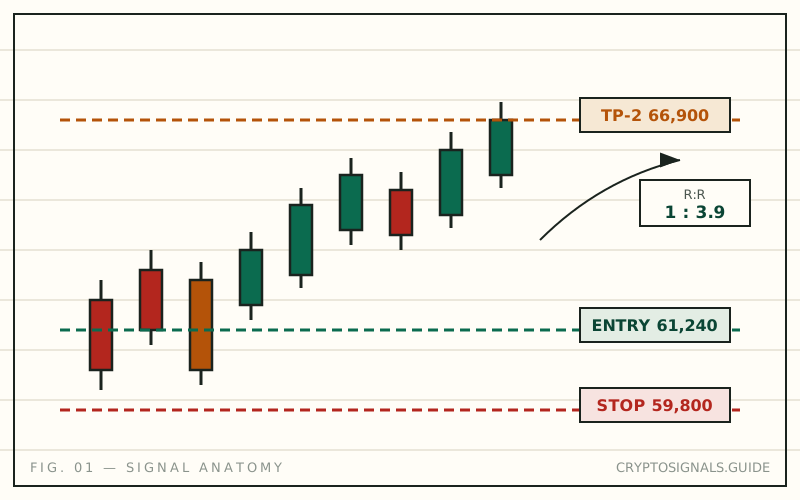
The definition, minus the hype
A crypto signal is a trade suggestion delivered as a message: trade this pair, in this direction, enter around this price, cut the loss here, take profit there. That's the entire product. It arrives over Telegram, Discord, a mobile app or a web dashboard, and it comes from one of three sources — a human analyst, a trading community, or an algorithm scanning the market.
The word "signal" borrows authority from radio and engineering, but nothing is transmitted from the market itself. Someone formed an opinion, structured it, and hit send. Whether that opinion came from a decade of disciplined chart-reading or thirty seconds of guesswork is invisible in the message — which is exactly why the industry's advertised win rates deserve suspicion. Where independent counts exist, tracked accuracy came in 10–27 percentage points below the claims; the receipts live in our accuracy tracker.
What's inside a signal message
A complete signal carries six fields. Missing fields are information too — a call with no stop-loss tells you the sender hasn't thought about being wrong.
- Pair — what to trade and against what, e.g. SOL/USDT.
- Direction — long (price rises) or short (price falls). Spot-only channels can only go long.
- Entry — a single price or, more often, a zone. Zones exist for honest reasons (fills are messy) and dishonest ones (a wide zone makes almost any outcome claimable as a win).
- Stop-loss — the level where the idea is declared wrong and the position closed.
- Take-profit targets — usually a ladder of three to six levels where you close portions of the position.
- Leverage — futures signals suggest a multiplier like 5x or 10x. This field moves risk more than every other field combined.
A signal dissected line by line
Here's a hypothetical but typical Telegram signal, followed by what each line commits you to:
"#BTC/USDT — LONG · Leverage: 5x · Entry: 64,000–65,000 · TP1 66,300 · TP2 67,600 · TP3 70,200 · SL 62,700"
- Long at 64,000–65,000: you're buying inside that band. Take the midpoint, 64,500, as your working entry.
- SL 62,700: your maximum planned loss is 64,500 − 62,700 = 1,800 per BTC — about 2.8% of the entry price. At the suggested 5x leverage, that 2.8% move costs roughly 14% of the margin you posted.
- TP1 66,300: the first cash-out sits 1,800 above entry — the same distance as the stop. Risk one unit to make one unit: a 1:1 first target.
- TP2 67,600 and TP3 70,200: 3,100 and 5,700 above entry — roughly 1.7:1 and 3.2:1 against your 1,800 risk. The later targets are where the trade's real payoff lives, if price ever gets there.
- What's missing: position size. The signal doesn't know your account. If you risk more than 1–2% of it on this one idea, no win rate can save you from a normal losing streak.
Deciphering ladders, "move SL to breakeven" instructions and bot-format quirks takes a full article — that's how to read crypto signals.
Who actually sends signals
Analysts and desks. One trader or a small team publishing their own setups. Quality spans the whole spectrum, and a big subscriber count proves marketing skill, not trading skill.
Communities. Discord servers and group chats where setups get posted and argued over. Slower, but public argument makes deleting bad calls harder.
Algorithms. Software watching indicators, order flow or on-chain data and firing alerts automatically — some firing 100+ per day. Volume is not accuracy: an untested algorithm is just a random-number generator with a dashboard. The largest ecosystem for all three sender types is Telegram; our Telegram channel ranking sorts the ones worth auditing from the noise.
The four business models behind every channel
Nobody sends trade ideas to strangers out of kindness. Every channel monetizes one of four ways, and knowing which one you're in changes how much to trust it:
- Subscriptions. You pay monthly (roughly $40–$370 across the market as of this update) for a VIP tier. Cleanest model — the provider profits from renewals, which at least points their incentive toward keeping you solvent.
- Referral kickbacks. The channel is free, but you're nudged to sign up at an exchange through the operator's link. They then earn a cut of your trading fees — meaning they profit from how often you trade, not how well.
- VIP funnels. The free channel is a storefront: selected wins get posted, losses quietly don't, and every message points to the paid group. Free tiers are for auditing a provider, never for trusting one.
- Pump schemes. The operator accumulates a thin coin, "signals" it to thousands of followers, and sells into the spike they create. The subscriber is not the customer here — they're the exit liquidity.
What signals are not
Not guarantees. Every provider posts losing streaks — the honest ones show them, the rest delete them. A "95% win rate" with no independent audit is a slogan.
Not financial advice. Providers label their calls "educational" specifically to stay outside investment-adviser regulation. The same disclaimer that protects them from the regulator removes any accountability to you.
Not a strategy. A signal tells you where to enter and exit — it says nothing about how much to stake, how many positions to run at once, or what to do when three stops hit in a week. Those decisions, not the calls, decide whether following signals is actually worth it.
Frequently asked questions
What are crypto trading signals in simple terms?
They are trade suggestions sent by an analyst, community or algorithm — typically a coin pair, a direction (long or short), an entry price, a stop-loss and one or more take-profit targets. You decide whether to execute them on your own exchange account.
Who sends crypto signals?
Three sources: individual analysts or small trading desks, communities where members share setups, and algorithms that scan markets automatically. Each can be competent or careless — the sender type alone tells you nothing about quality.
Are crypto signals financial advice?
No. Providers publish them as educational trade ideas precisely to avoid being regulated as investment advisers. That framing also means nobody is accountable if you lose money following them.
How do free crypto signal channels make money?
Mostly through VIP upsells and exchange referral kickbacks: the operator earns when you upgrade to a paid tier or trade through their affiliate link. The worst cases earn by using subscribers as exit liquidity in pump schemes.
Do crypto signals guarantee profit?
Never. Where independent counts exist, real win rates came in 10–27 percentage points below advertised figures, and even genuinely good signals produce losing streaks. Anyone promising guaranteed returns is showing you a red flag, not an offer.
Crypto assets are volatile and largely unregulated. Signal services — including every service mentioned on this page — can and do post losing streaks. Never trade with money you cannot afford to lose, and never treat a paid subscription as a guarantee of profit.
We test crypto signal providers with real subscriptions and log every published call — entries, stops and targets — before scoring anyone. Read how we test →