
Disclosure: no provider is promoted on this page and none paid to appear in the data. One sponsored exchange banner is marked below. How affiliate links work sitewide — and why they can't touch a score — is in our testing methodology.
The short answer
Crypto signals are worth paying for in one narrow case: a provider with an independently verifiable track record, calls whose risk-reward survives honest math, and a subscription fee that's small relative to your trading capital. Miss any one of the three and the subscription is a slow leak; miss two and it's a donation.
That's not cynicism — it's what the logged data shows. Let's walk through the three tests in order, numbers first.
What the tracked numbers say
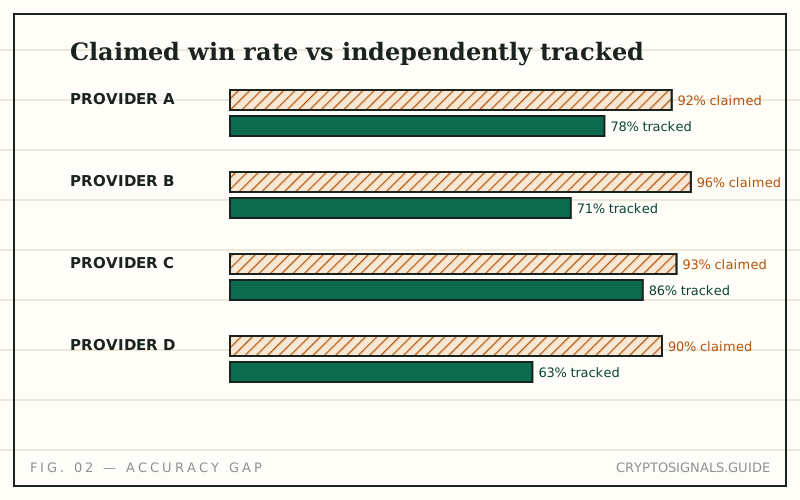
Marketing win rates are self-reported. Whenever we or another third party counted every published call, the claims shrank:
Two readings of the same chart. Pessimistic: even a large, established channel inflated its headline number by 14 points. Optimistic: both channels survived an independent count at all — 77.8% and 86.44% are real, non-trivial hit rates. Meanwhile the most credible-sounding number in our dataset might be the least flattering one: Rocket Wallet Signals self-reports just 63.35%. A provider willing to publish a six-handle win rate is telling you it counts its losers.
The pattern across the niche — including the "96.5%" and "up to 96%" claims that no audit has ever touched — is laid out provider by provider in the accuracy tracker. The typical claim-to-tracked gap runs 10–27 percentage points.
The win-rate fallacy, with arithmetic
Here's the uncomfortable part: even the tracked win rate doesn't tell you whether followers made money. Win rate ignores the size of wins versus losses. Run a hypothetical but painfully common scenario:
- A channel wins 78 of 100 trades. Sounds excellent.
- Winners get closed early at the first target: average +0.5R (half of what was risked).
- Losers run to the full stop: −2R each, because the "stop" got widened twice on the way down.
- The ledger: 78 × 0.5R = +39R won; 22 × 2R = −44R lost. Net: −5R over 100 trades — before a single dollar of fees or subscription costs.
A 78% win rate, and every follower is down. Flip the shape — 40% win rate with +3R winners and −1R losers gives 40 × 3 − 60 × 1 = +60R — and a "worse" channel makes money. The single number that combines both is expectancy: (win rate × average win) − (loss rate × average loss). No expectancy disclosure, no verdict — which is why our reviews compute it instead of quoting hit rates. If reading targets and stops in R-terms is new to you, the mechanics are in how to read crypto signals.
The subscription hurdle on a small account
The fee is the one number in this business that is always real. Take an actual price point from the premium end of the market — ~$290/month, what Binance Killers VIP costs as of this update — and hold it against a beginner-sized account:
- Annual cost: $290 × 12 = $3,480.
- On a $3,000 account, the signals must generate a 116% annual return before you earn your first dollar. That's the fee alone — before trading fees, slippage and losing streaks.
- On a $30,000 account the same fee is an 11.6% hurdle. On $100,000, 3.5%. The identical subscription is absurd for one reader and reasonable for another.
Rule of thumb from that arithmetic: if a year of fees exceeds 5–10% of your trading capital, the subscription is mathematically working against you regardless of signal quality. Cheaper tiers change the numbers, not the logic — an $89/month channel still needs $1,068 of profit a year just to go flat.
When signals genuinely help
After all that skepticism, the honest flip side — there are situations where a decent signal service earns its fee:
- You already manage risk, but lack screen time. A provider watching charts all day genuinely substitutes for hours you don't have; you keep the sizing decisions.
- You need structure to stop impulse-trading. Defined entry, stop and targets — executed as written — beat the "saw a tweet, went all-in" pattern that empties beginner accounts.
- You use calls as a study set. Following a transparent channel's wins and losses for months, with real R:R noted on every trade, is a cheap education in setups — cheaper still if you paper-trade it.
- Your account clears the fee hurdle. Per the math above: the same $89 that's poison on $2,000 is background noise on $50,000.
What signals never do is turn trading into passive income. Every disaster story we've reviewed starts with someone treating a subscription like a dividend.
How to decide without burning a year of fees
You don't need to pay to find out. Track any channel's free feed for 30 days, logging every call with its timestamp, entry, stop and targets — then compute the win rate and expectancy yourself and compare against what the channel advertises. The full method, including the 10 questions that disqualify a provider before you even start counting, is our provider vetting guide. And before trusting any number a channel shows you, check whether it survived anyone else's count in the accuracy tracker — the same standard we apply to ourselves is documented in how we test.
Frequently asked questions
Do crypto signals actually work?
Some do, most underdeliver. Where independent counts exist, tracked win rates ran 10–27 percentage points below the advertised ones — Binance Killers claimed 92% and tracked at 77.8%, WolfxSignals claimed 93.37% and tracked at 86.44%. A real edge can survive that haircut; a marketing number can't.
Can a high win rate still lose money?
Yes. If winners are small and losers are large, a 78% win rate loses money: 78 wins at +0.5R earn 39R while 22 losses at −2R cost 44R — a net −5R over 100 trades. Expectancy (win rate combined with average risk-reward) is the number that matters.
Are paid crypto signals worth the subscription price?
Only if your account is large enough that the fee is a small hurdle. A $290/month subscription costs $3,480 a year — on a $3,000 account that's a 116% annual return required just to break even on the fee. On a $50,000 account the same fee is a 7% hurdle.
Which crypto signal providers publish honest numbers?
The honest tell is a loss-inclusive record and modest claims. Rocket Wallet Signals self-reports 63.35% — unglamorous and therefore credible-looking; Fat Pig Signals has published its losing trades since 2018. Verify any claim against an independent count before paying.
When do crypto signals genuinely help?
As structured trade ideas for someone who already sizes positions properly: they save screen time, provide defined entries and exits, and impose discipline. They don't help as a substitute for risk management or as a passive-income product — that expectation is what the losses are made of.
Crypto assets are volatile and largely unregulated. Signal services — including every service mentioned on this page — can and do post losing streaks. Never trade with money you cannot afford to lose, and never treat a paid subscription as a guarantee of profit.
We test crypto signal providers with real subscriptions and log every published call — entries, stops and targets — before scoring anyone. Read how we test →