
Disclosure: an educational page — nothing here is ranked or paid for. One sponsored exchange banner appears mid-article, labeled as such. Our full affiliate policy lives in the testing methodology.
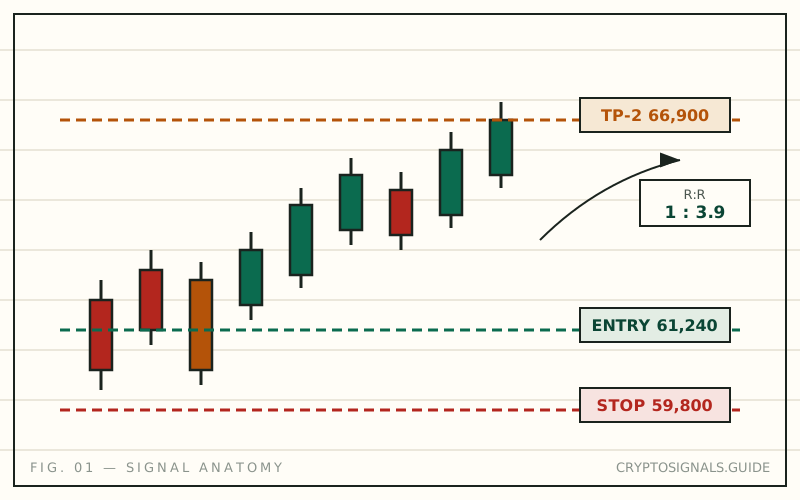
The anatomy at a glance
Signals compress a full trade plan into a few lines. A representative hypothetical futures call:
"#SOL/USDT — LONG · Lev: 5x cross · Entry: 138–142 · TP: 146 / 150 / 156 / 165 · SL: 131"
Read it as five instructions: buy Solana against USDT somewhere between 138 and 142; borrow up to 5x your margin; start taking profit at 146 and keep scaling out through 165; if price hits 131, the idea is dead — close everything. Each field has its own conventions and its own traps, so let's take them in order.
Entry zones vs single entries
A single entry ("Entry: 140") is precise but brittle: price may never touch your exact number, and in a fast market your fill can be worse. Zones exist because real fills are messy — providers expect you to ladder buy orders across the range or take the midpoint.
The honest zone is narrow relative to the trade. In the example above, the zone spans 4 points while TP1 sits 6 points above the zone midpoint — reasonable. When you see a zone nearly as wide as the distance to the first target, be suspicious: a provider can later claim the trade "won from the bottom of the zone" no matter what happened. Wide-zone accounting is one of the classic tricks we test for when vetting a signal provider.
One more rule: if price has already run past the zone by the time you see the call, the signal has expired. Chasing an entry 3% above where the analyst planned it silently destroys the risk-reward the whole message was built on.
Stop-loss: where and why
The stop-loss is not decoration — it's the only field that caps what the idea can cost you. Competent providers place it beyond a technical level: under the swing low the setup depends on, below a support shelf, outside the range that would prove the thesis wrong. That's why stops sit at "odd" distances like 4.8% rather than round numbers.
Three things to check the moment you read one:
- Distance. Entry midpoint 140, stop 131 → 9 points, about 6.4%. That number feeds directly into position sizing: risking 1% of a $5,000 account ($50) across a 6.4% stop means a position of roughly $50 ÷ 0.064 ≈ $780. The stop distance, not your mood, sets the size.
- Leverage interaction. At 5x, that 6.4% adverse move costs about 32% of posted margin. Wide stop plus high leverage is how "one bad trade" becomes "half the account".
- Presence. No stop in the message means the provider carries no downside plan. Skip the trade, and honestly, skip the channel.
Take-profit ladders and the breakeven rule
Most channels publish three to six targets rather than one exit. The convention: close a fixed slice of the position at each level — a common split for a four-target ladder is 40/30/20/10, front-loaded because TP1 gets hit far more often than TP4. The early targets pay for the trade; the tail targets are the lottery ticket that occasionally pays for the month.
Alongside the ladder you'll meet the most misread instruction in the format: "after TP1, move SL to breakeven (BE)." It means: once the first target fills, drag your stop-loss up to your entry price. The remaining position now has a worst case of roughly zero (minus fees) instead of a loss. It's how disciplined followers make sure a trade that was already partly banked can't swing back and take the gains with it. The cost: price often retests the entry before continuing, so breakeven stops get tagged on trades that would have hit TP3. That trade-off is inherent — the rule trades some upside for the certainty that winners stay winners.
Risk-reward: the worked example
Risk-reward (R:R) is the number that decides whether a win rate means anything. Using the SOL signal, entry at the 140 midpoint, stop 131 — so one "R" = 9 points of risk. Now measure each target:
- TP1 146: +6 points → 6 ÷ 9 ≈ 0.67R
- TP2 150: +10 points → 10 ÷ 9 ≈ 1.1R
- TP3 156: +16 points → 16 ÷ 9 ≈ 1.8R
- TP4 165: +25 points → 25 ÷ 9 ≈ 2.8R
Suppose you scale out 40/30/20/10. Your blended reward if every target hits: (0.4 × 0.67) + (0.3 × 1.1) + (0.2 × 1.8) + (0.1 × 2.8) = 0.27 + 0.33 + 0.36 + 0.28 ≈ 1.24R. So the trade risks 1 to make about 1.24 in the best case — and less whenever the ladder only partially fills. That's the sober way to read a signal that markets itself with the "165 target": most of your money exits at 0.67R and 1.1R.
This is also why advertised win rates can't be evaluated alone. A channel hitting TP1 78% of the time at 0.67R while eating full 1R losses the other 22% is barely breaking even before fees — the full expectancy math is in are crypto signals worth it.
Leverage notation
Futures signals write leverage as "5x", "10x", sometimes "Lev: 5–10x cross" or "isolated 20x". Decode it in two steps. Cross vs isolated: isolated margin risks only what you posted to that position; cross lets a losing trade drain your whole futures wallet before liquidating. The multiplier: it scales your loss per adverse percent — 2% against you costs 10% of margin at 5x, 20% at 10x, 40% at 20x.
Treat the suggested figure as the provider's maximum, chosen to make their percentage screenshots look dramatic. Nothing stops you from taking a "20x" call at 3x — the entry, stop and targets don't change; only your survival odds do. Channels that lead with high leverage are ranked and risk-flagged in our futures signals guide.
Notation quirks and bot-readable format
Shorthand varies by channel; these are the recurring ones:
- "Entry: CMP" — current market price: enter now, at whatever price is on screen.
- "TP: 146 – 150 – 156" — dashes, slashes and arrows all mean the same ladder.
- "SL: H4 close below 131" — a conditional stop: exit only if a 4-hour candle closes below the level, not on a wick. More forgiving, more discretionary.
- "Margin: 2%" — how much of your account the provider assumes per trade. If absent, that decision is yours; make it before entering, not after.
- Percent targets ("TP1 +3%") — targets relative to entry rather than absolute prices. Recompute them into prices immediately so your exchange orders are unambiguous.
The tidy "pair / direction / leverage / entry / ladder / stop" structure isn't just style — it's a machine format. Automation tools are built to parse exactly these blocks and turn them into live orders with your own size caps, which is why sloppily formatted channels literally can't be automated. If reading each field now feels mechanical, that's the point — the format was designed for machines, and the comparison of tools that execute it lives in our signal bots guide.
Frequently asked questions
What do TP1, TP2 and TP3 mean in a crypto signal?
They are laddered take-profit targets. Instead of closing the whole position at one price, you close portions at each level — for example 50% at TP1, 30% at TP2, 20% at TP3 — locking in gains while leaving room for the bigger move.
What does "move SL to breakeven after TP1" mean?
Once the first take-profit fills, you move your stop-loss up to your entry price. From that point the worst case on the remaining position is roughly zero loss (before fees), so a winner can no longer turn into a loser.
Should I enter at a single price or use the whole entry zone?
Common practice is to split the order across the zone or use its midpoint. Be aware that wide zones also let dishonest providers claim wins from whichever edge filled — compare the zone width to the distance to TP1 before trusting it.
How do I calculate risk-reward from a signal?
Risk = entry minus stop-loss; reward = target minus entry. Divide reward by risk for each target. If you plan to scale out across a ladder, weight each target by the portion you close there to get the trade's blended R:R.
What does 5x or 10x leverage in a signal mean?
It multiplies your exposure relative to the margin you post: at 10x, a 2% adverse move costs about 20% of your margin. Leverage changes how much you can lose, not the quality of the idea — treat suggested leverage as a ceiling, not a requirement.
Crypto assets are volatile and largely unregulated. Signal services — including every service mentioned on this page — can and do post losing streaks. Never trade with money you cannot afford to lose, and never treat a paid subscription as a guarantee of profit.
We test crypto signal providers with real subscriptions and log every published call — entries, stops and targets — before scoring anyone. Read how we test →