
Disclosure: this page carries no affiliate links and no provider paid to appear in — or stay out of — this table. Reviews linked from it may contain marked affiliate links; scores and tracked figures follow our testing methodology regardless.
How this table is built
Three kinds of numbers appear below, and the labels matter more than the digits:
- Tracked — an independent party (our desk, per our protocol, or a third-party auditor) logged every published call before its outcome was known and counted it under one rule, fees and realistic fills included.
- Self-reported — the provider's own number, but published as a loss-inclusive record rather than a marketing slogan. Better than nothing; not the same as an audit.
- Unverified — a marketing figure with no independent count behind it. Unverified isn't proof of fraud, but until someone counts, it's ad copy.
The table updates as new tracking data lands; the date stamp above is the last revision. If you operate one of these services and believe a figure is wrong, the correction route is our contact page — with your full trade log, not a screenshot.
The tracker: claimed vs verified
| Provider | Claimed win rate | Independent count | Gap | Status |
|---|---|---|---|---|
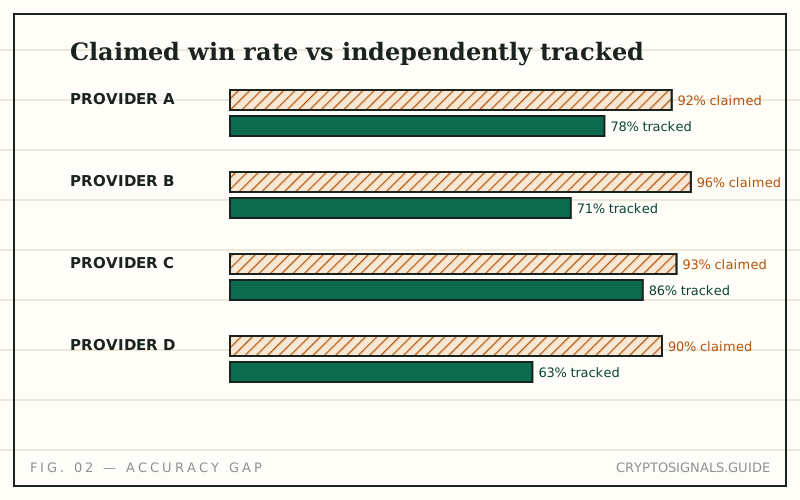
| Binance Killers | 92% | 77.8% | −14.2 pp | Tracked |
| WolfxSignals | 93.37% | 86.44% | −6.93 pp | Tracked |
| Rocket Wallet Signals | 63.35% (own figure) | — | — | Self-reported |
| Fat Pig Signals | No headline claim | — | — | Public track since 2018 |
| SignalCLI | "90%+" (Reckless Mode) | none | n/a | Unverified |
| Wallstreet Queen Official | 96.5% | none | n/a | Unverified · no audit |
| Universal Crypto Signals | "up to 96%" | none | n/a | Unverified |
| Raven Signals Pro | ">90%" | none | n/a | Unverified |
| Bitcoin Bullets | ~75% | none | n/a | Unverified |
The gaps, visualized
Where both a claimed and an independently tracked figure exist, here's the distance between the ad and the count:
Note the asymmetry in what these two rows mean. Binance Killers' 14.2-point gap is a marketing problem: the tracked 77.8% is respectable, but the channel sells the 92%. WolfxSignals' 6.93-point gap is among the smallest we've recorded — still an inflation, but close enough to its claim that the claim carries some information. Both full stories: the Binance Killers review and the WolfxSignals review.
Why the gaps happen: three mechanics, no conspiracy
You don't need to invent trades to inflate a win rate. The standard toolkit is subtler:
- Deleted losers. A losing call quietly disappears from the channel, and the monthly recap totals only what survived. Our logs keep deleted posts; recaps don't. This alone can move a win rate by double digits on a bad month.
- Entry-zone cherry-picking. A signal gives a wide entry zone — say a 3% band. If price dips into the far edge and reverses, the recap grades the trade from the most flattering fill in the zone. Graded from the price a subscriber could realistically get, the same trade is often a loss.
- Unrealistic fills, free trading. Recap math assumes zero fees, zero slippage and instant execution on targets touched for seconds. Real accounts pay taker fees both ways and chase entries that a 100,000-subscriber broadcast just moved. On scalp-frequency strategies, costs alone eat several points.
Stack all three and a channel that genuinely wins two trades out of three can advertise "90%+ accuracy" while technically never typing a false trade. That's why the only number we treat as performance data is a full count of every published call — the standard our methodology applies and our vetting guide teaches you to apply yourself.
The honest outliers
Two rows in the table deserve their unusual green badges. Rocket Wallet Signals publishes a self-reported 63.35% win rate — a figure so unglamorous it's almost certainly real, in a niche where everyone else claims 90-something. And Fat Pig Signals skips the headline number entirely, maintaining a public track record since 2018 that includes its losing trades — the single strongest transparency signal a provider can send.
The pattern is worth internalizing: in crypto signals, modest numbers correlate with honesty, and spectacular numbers correlate with marketing. It's the inverse of what the ads train you to expect, and it's the main reason loss-inclusive providers outrank bigger names in our review index.
Audit a channel yourself in 30 days
You can replicate a lighter version of our protocol with a spreadsheet and patience, before risking a dollar:
- Join the free channel and log everything for 30 days. The moment a call appears, record timestamp, pair, direction, entry/zone, stop, and all targets. Screenshot it — screenshots can't be edited by the admin later.
- Grade against real prices, one rule for every trade. Win = targets hit before the stop at a fill you could realistically get. Grade entry zones from their worst edge. Subtract your exchange's fees.
- Count deletions as losses. If a logged call vanishes from the channel, that's your answer about the provider's recap math.
- Compare your tally to the advertised rate. A few points of drift is normal. A 15-point gap means the marketing number is fiction — and the funnel tactics described in our scam warning hub usually aren't far behind.
Thirty days won't match a 90-day window, but it's enough to catch the worst behavior — and it costs nothing except the VIP subscription you didn't buy yet.
Accuracy tracker FAQ
What counts as "independently tracked" here?
Someone other than the provider logged every published call before the outcome was known and graded all of them under one consistent rule, fees and realistic fills included. A provider's own recap of its winning trades doesn't qualify, no matter how detailed.
Why is the typical gap 10–27 percentage points?
Because the three standard mechanics — deleted losers, flattering entry-zone grading, and cost-free fill math — each add a few points, and most channels use all three at once. The gap isn't one big lie; it's an accumulation of small grading choices that all point the same direction.
Does "unverified" mean the provider is a scam?
No — it means exactly what it says: nobody independent has counted. Bitcoin Bullets' ~75% claim is plausible precisely because it's modest; Wallstreet Queen's 96.5% with an anonymous operator is a different risk profile. The reviews spell out which unverified claims come with additional red flags.
Is a high win rate even the right thing to look for?
Not by itself. A 78% win rate with small winners and oversized losers loses money; a 55% win rate with 2:1 reward-to-risk makes it. Check average risk-reward alongside the hit rate — the arithmetic is worked through in are crypto signals worth it.
How often is this page updated?
Whenever a tracking window closes or a credible third-party audit surfaces — the "Updated" date at the top reflects the last revision. Providers can submit corrections with full trade logs via our contact page.
Crypto assets are volatile and largely unregulated. Signal services — including every service tracked on this page — can and do post losing streaks. Never trade with money you cannot afford to lose, and never treat a paid subscription as a guarantee of profit.
We test crypto signal providers with real subscriptions and log every published call — entries, stops and targets — before scoring anyone. Read how we test →