
Affiliate disclosure: Rocket Wallet Signals runs a referral-based access programme and we are not part of it — this review earns us nothing from the provider. Other links on this page may be affiliate links per our disclosure policy; none of them move a score, which is set by our published testing methodology.
- Platform
- Telegram — free channel + VIP (access by referral)
- Focus
- Spot and futures calls
- Pricing (July 2026)
- $150/mo · $390/3mo
- Claimed win rate
- 63.35% — self-reported by the provider
- Independently tracked
- Could not verify — no third-party count exists
- Audience
- 31,000–37,000 subscribers
- Affiliate program
- Yes — referral-based
- Risk level
- Moderate — unaudited figures, active clone problem
Rocket Wallet Signals scores 6.1 mostly for refusing to lie about the easy thing. A provider that publishes 63.35% has done something almost nobody in this category does: quoted a figure a working trader would recognise as real. The service is genuine, priced openly at $150 a month, and puts visible effort into shutting down channels impersonating it. What it still hasn't done is let anyone else count — self-reported is a better starting point than fantasy, but it is not verification, and there are subscriber complaints in the record.
What Rocket Wallet Signals is
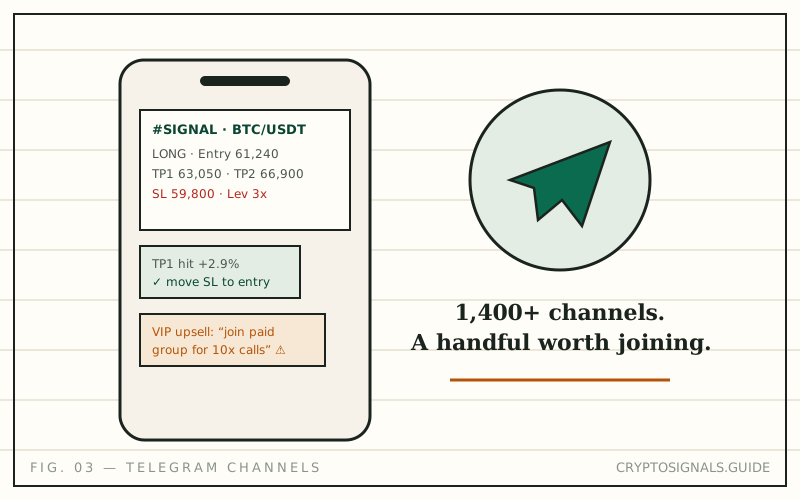
Rocket Wallet Signals runs the familiar two-tier Telegram structure — free public channel, paid VIP group — with a subscriber base reported between 31,000 and 37,000. Calls cover spot and futures, so slower accumulation ideas and leveraged setups arrive in the same feed.
One structural quirk: VIP access is arranged by referral rather than through an open checkout page. Not unusual in this corner of Telegram, and not a warning sign by itself — but it means the price you're quoted arrives in a private message, so screenshot it. That chat is your only receipt when renewal comes around. The calls themselves use the standard shape: pair, direction, entry, stop, targets, unpacked field by field in our guide to reading a crypto signal.
Why 63.35% is the most useful number in this niche
Spend a week reading crypto signal marketing and the win rates blur together: 92%, 96.5%, "up to 96%", "over 90%". Then Rocket Wallet posts 63.35% and the page reads differently.
Marketing numbers are chosen; measured numbers are found. Nobody fabricating a figure to sell subscriptions lands on sixty-three — they land north of ninety, because that's what converts. The two decimal places point the same way: 63.35% is what falls out of dividing wins by trades in a real spreadsheet, not what a copywriter picks. It's a number that costs the provider sales, which is exactly why it's worth crediting.
Now the part most readers get backwards: 63% is plenty. Win rate on its own decides nothing — it only matters next to the size of the average win against the average loss. The break-even payoff ratio is simply the loss rate divided by the win rate:
- At 63% wins: 37 ÷ 63 = 0.59. Your average winner only has to be 59% the size of your average loser to break even before fees.
- At a claimed 95%: 5 ÷ 95 = 0.05. Sounds unstoppable — until you notice that a 95%-win system usually gets there by holding losers open, so the rare loss can be twenty times a win and wipe out a quarter of gains in one trade.
A 63% hit rate at 1:1.5 risk-reward compounds. A 95% hit rate with no stop discipline blows up. That's the whole argument for the honest number, and why this provider carries the unusual "self-reported" badge in our accuracy tracker rather than the red "unverified" flag most 90%-claimers get.
What self-reported still can't prove
Credit given, now the limits. Self-reported means the provider counted its own trades and told you the answer. Three questions stay open:
- Which trades were counted? A win rate is only as good as its denominator. Drop cancelled entries, unfilled setups and "we're watching this one" posts, and the percentage climbs without a single trade improving.
- What counted as a win? Tagging take-profit 1 and then reversing into the stop is a win in some channels' bookkeeping and a loss in yours. Fees, perp funding and slippage on thin alt pairs rarely appear in anyone's self-count.
- Over what window? Any sample can be started and stopped where it flatters. A rolling timestamped log makes that impossible; a headline figure doesn't.
Neither we nor any third party we could find has logged a full 90-day window of this channel's calls, which is why the scorecard reads "could not verify" rather than a number. Same standard as every provider here — the difference is that this figure sits where an independent count could plausibly land, instead of thirty points above it. Our testing methodology sets out what a tracked number actually requires.
Pricing: $150 a month, and the hurdle it creates
| Plan | Price (July 2026) | Effective monthly |
|---|---|---|
| Monthly | $150 | $150 |
| Quarterly | $390 | $130 |
| Lifetime | Not offered / not disclosed | — |
$150 is mid-to-upper market: cheaper than the $240–290 tier, roughly double the $69–89 channels. Quarterly saves $60, and the absence of a "lifetime" upsell is quietly a good sign — lifetime tiers exist to harvest cash before trust can be tested.
Then do the arithmetic that actually decides this purchase. On a $3,000 account, $150 a month is 5% of capital every month — 60% a year — that the signals must earn back before you see a cent. No 63% system clears that reliably on a small balance. At $20,000 the same fee is 0.75% a month, a rounding error against one decent swing. The fee doesn't change; its weight does. That's the first calculation we'd run before subscribing to anything in the Telegram signals field.
Complaints and the impersonator war
Two things sit on this side of the ledger, pulling in opposite directions.
Complaints exist. Our research turned up dissatisfied subscribers — the ordinary kind attached to almost any paid channel: losing runs, expectations above delivery, arguments about value for the fee. No exit-scam pattern, no vanished channel, no compensation-scheme mechanics. But complaints are a fact and belong in the record, and they're part of why a 63.35% self-report doesn't lift this into the sevens. The useful question is whether the unhappiness clusters around billing and disappearances or around losing trades. Here it reads as the second kind.
They fight impersonators. Rocket Wallet actively works against clone channels copying its name and avatar — worth more credit than it usually gets, because chasing fakes costs time and earns nothing. A brand that polices its own name is behaving like one that intends to be here next year. It also confirms the clone problem is real, so, plainly:
- Nobody legitimate ever direct-messages you first asking for a deposit or a wallet transfer.
- Check the exact handle against the channel the free feed links to — clones differ by an underscore or a capital letter.
- "Manage your funds for you" is never part of a signal subscription. That pattern and its relatives are catalogued in our scam warning hub.
Who Rocket Wallet Signals suits
Reasonable fit: a trader with a five-figure account who wants extra idea flow across spot and futures and will keep their own log rather than trusting the headline percentage. Start monthly, count for yourself, then decide about quarterly.
Skip it if: you're trading a few thousand dollars and the fee eats the edge, you need an audited record before paying, or you expect the win rate to do the work. Undecided about paid signals generally? Read are crypto signals profitable first — the answer turns on your account size more than on any provider.
Where it's strong
- Publishes a realistic 63.35% instead of a marketing 90-something
- Prices stated openly: $150/mo, $390/quarter
- No lifetime tier harvesting cash up front
- Actively hunts and reports impersonator channels
- 31–37k subscribers with a free tier you can audit before paying
Where it isn't
- The 63.35% is self-counted — no audit, no third-party log
- Sample rules undisclosed: no stated window, no fee-inclusive maths
- Subscriber complaints on record
- $150/mo is a heavy hurdle under roughly $10k of capital
- Referral-gated access means prices arrive in private messages
- Clone channels using the name are a live risk
Alternatives worth comparing
- Fat Pig Signals — the step up from honest to provable: a public track record since 2018 that includes the losing trades.
- WolfxSignals — claimed 93.37%, independently tracked 86.44%, at $89/month. A high claim that mostly survived counting.
- OnwardBTC — $69/month and roughly one signal every two to three days, with a third-party "approved" rating.
For the wider field, our Telegram channel ranking lists every provider with its evidence attached.
How we scored it: 6.1/10
Against our weightings, verified performance stays empty — nobody outside the channel has counted, so the heaviest 35% scores on potential rather than proof. Transparency is where Rocket Wallet earns its position: an unflattering, precise figure and plainly stated prices, docked only because the counting rules aren't published. Value is mid-pack at $150. Risk practices come out well — real venues, no pump talk, no compounding promises, active policing of impersonators. Complaints and the missing independent log keep this at 6.1 rather than the sevens where loss-inclusive providers sit.
Rocket Wallet Signals FAQ
Is Rocket Wallet Signals legit?
A real, operating channel with 31,000–37,000 subscribers, open pricing and a plausible win rate. Not audited, and complaints exist — so: a real service with unverified numbers, not a proven one.
How much does Rocket Wallet Signals VIP cost?
$150 a month or $390 a quarter as of July 2026 — $130/month quarterly. Access comes via referral rather than a public checkout, so get the quoted price in writing.
Is a 63.35% win rate actually good?
It's realistic, which is more useful. At 63% wins your average winner needs to be only about 0.59× your average loser to break even before fees. Compare a 95% claim, where one oversized loss undoes twenty wins.
Has anyone independently verified the 63.35%?
No — it's the provider's own count, with no published sample window or fee treatment. Our tracker lists it as self-reported for exactly that reason.
Why do fake Rocket Wallet channels exist?
Big channels attract clones that copy the name and DM members for deposits. Rocket Wallet reports them, to its credit — but the rule stands: nobody legitimate messages you first asking for money.
Is $150 a month worth it?
Depends on your balance. On $3,000 that's a 5% monthly, 60% annual hurdle before any trade; on $20,000 it's 0.75% a month. Below roughly $10,000 the subscription is usually the biggest risk on your book.
Crypto assets are volatile and largely unregulated. Signal services — including Rocket Wallet Signals — can and do post losing streaks, and a 63% win rate guarantees losing runs by definition. Never trade with money you cannot afford to lose, and never treat a paid subscription as a guarantee of profit.
We test crypto signal providers with real subscriptions and log every published call — entries, stops and targets — before scoring anyone. Read how we test →