
No affiliate relationship: Raven Signals Pro operates an affiliate programme. We are not in it, we earn nothing from this page, and we would not take a commission for promoting an accuracy claim nobody has verified. Other links here may be affiliate links per our disclosure policy; scores are set only by our testing methodology.
- Platform
- Telegram
- Markets
- Crypto + forex
- Pricing (July 2026)
- Discounted lifetime access — figures not published
- Claimed win rate
- "Over 90%"
- Independently tracked
- Could not verify — no third-party count exists
- Audience
- Not disclosed
- Team
- Not disclosed
- Affiliate program
- Yes — no relationship with us
- Risk level
- Elevated — unverifiable claim, opaque lifetime pricing
Raven Signals Pro sells the two things we trust least in combination: a win rate above 90% that nobody has counted, and a lifetime membership whose price isn't published. Neither proves dishonesty — plenty of small channels are just sloppy about evidence — but together they leave a buyer nothing checkable to decide on. 4.7 is what an unverifiable offer earns: not an accusation, an absence. Don't pay a lifetime fee to find out; spend 30 days counting instead.
What Raven Signals Pro is
Raven Signals Pro is a Telegram signal channel covering crypto and forex, sold through discounted lifetime access. A small but genuine trickle of people search the brand by name each month, which is why this page exists — somebody is being pitched this channel and deserves a documented answer rather than a promoted link.
The mixed-market angle is worth a note. Crypto and forex behave nothing alike: different sessions, spreads, leverage regimes, different reasons a stop gets hit. Spanning both isn't automatically worse, but a single blended win rate across the two is close to meaningless — the trader who wants EUR/USD setups and the one who wants altcoin swings are being sold the same number about two different products.
The "over 90%" claim, and why it can't stand
Here's the thing about "over 90%": it isn't false on its face, it's unfalsifiable as written. No sample size, no date range, no definition of a win, no fee treatment, no log to inspect. A statement built that way can't be wrong, because there's nothing in it to be wrong about — and that's not an accident of phrasing. A provider who counted properly would give you the denominator, because the denominator is the proof.
Set it against the record we do have. Across everything we've measured or found outside counts for, the best tracked results land in the mid-80s, and providers publishing loss-inclusive logs show visible losing streaks inside those numbers. Nobody who opens their books comes out above 90. Our accuracy tracker lists Raven Signals Pro as unverified, and this page has no claimed-versus-tracked bars because the second column is empty.
And even if it were true, the number hides the thing that decides your account. A channel can win nine trades in ten at 0.5% each, give it all back on the tenth at 6%, and still advertise 90% honestly. Ask for average R multiple and maximum drawdown, or the accuracy figure is decoration — the profitability maths is worked through in our learn section.
Test a 90% claim yourself in 30 days
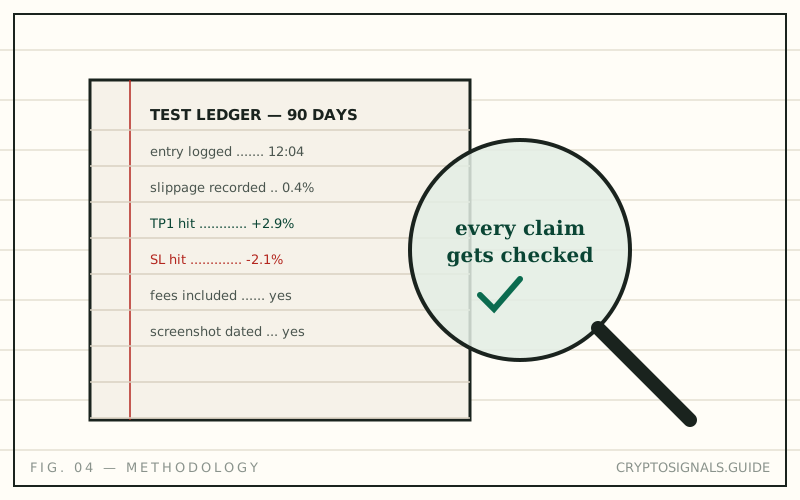
You don't need our subscription budget to settle this — a spreadsheet, a month, and the discipline to write the rules down before you start. Run it on the free channel, on paper, with nothing at risk:
- Define a win first. One sentence, saved before the first signal: "a win is price reaching take-profit 1 before the stated stop is touched; anything else is a loss." Deciding afterwards is how everyone accidentally flatters a provider.
- Set an entry rule. Assume the worst price in the stated zone, and only count the trade if that price traded after the message timestamp. A call that arrives already in profit doesn't count — you couldn't have taken it.
- Screenshot every call as it lands. Screenshots survive edits and deletions; your memory of "I think it said a 2% stop" doesn't.
- Charge yourself the real costs. Roughly 0.05% taker each side, funding on perpetuals held past eight hours, a slippage haircut on thin alts. A "win" that clears take-profit by 0.1% is a loss after costs.
- Count the ones that don't resolve. Entry never filled within 24 hours: void. Still open at day 30: score it at market. Deleted calls: losses — that's the only way to price a deletion.
- Do the arithmetic. Wins ÷ total, then the number that actually matters: average winning R against average losing R.
Now the part that makes 30 days enough. A daily-posting channel gives you roughly 25–35 completed trades in a month — small for confirming a modest edge, plenty for demolishing an extreme claim. If a channel truly wins 90% of the time, over 30 trades it produces 24 or more wins about 97% of the time. That's a hard threshold:
- 24+ wins in 30: the claim survives this round. Keep logging — you've ruled out nothing about risk-reward.
- Fewer than 24: a real 90% system fails that badly about once in forty months. Consider the claim refuted.
- Around 20 of 30 (67%): a perfectly decent trading result and a false advertisement at once. Both facts matter; only one was in the pitch.
Thirty days of patience costs nothing. A lifetime membership costs whatever they quote, permanently. Same discipline we apply at scale in our testing methodology — we just run bigger samples and pay for the VIP tier.
Lifetime access at an unpublished price
Access is advertised as discounted lifetime membership. We could not source the figures, and we don't print prices we can't confirm — so the scorecard says "not published" and this section has no invented numbers in it.
What can be said is what the structure does. Lifetime pricing settles your whole relationship with the provider in one payment, before you have any evidence, and promises a permanence it can't deliver: it's the channel's lifetime, not yours, and Telegram brands rename or go quiet routinely. No refund mechanism survives crypto leaving your wallet, and a discount quoted without a list price compares to nothing.
If you engage anyway, get three things in writing first: the exact amount, the payment method, and what happens if the channel stops posting. A provider who won't put a price in a message is previewing how the dispute will go.
What we could not verify
For the record, because the absence is the finding here:
- Track record: no third-party count, no audit, no loss-inclusive log.
- Prices: no confirmable figures for any plan.
- Team: no named operator, company or jurisdiction.
- Audience: no disclosed subscriber count.
- Independent reviews: nothing substantial from traders; the footprint is thin beyond the brand's own marketing.
An affiliate programme does exist, which explains some of the promotional coverage elsewhere: pages ranking this channel may be paid to. We hold no relationship with the provider and would decline one on a claim like this. If Raven Signals Pro publishes a timestamped, fee-inclusive log, we'll count it and update the score — that offer stands for every provider, via our contact page.
Who Raven Signals Pro suits
Maybe, with conditions: a trader who follows both crypto and forex, has already run the 30-day count on the free feed, and got a result they can live with. In that order — count, decide, then pay only if your own numbers justify it.
Skip it if: you're being asked for a lifetime payment on the strength of the 90% line, you can't get the price in writing, or you're new enough that a confident number feels like evidence. Start instead with how to vet a signal provider, which turns this review's instincts into a reusable checklist.
Where it's strong
- A real channel with a genuine, if small, branded following
- Covers forex as well as crypto — useful if you trade both
- A free feed exists to observe before paying
- No exit-scam or pump-scheme pattern surfaced in our research
Where it isn't
- "Over 90%" with no sample, no window, no log — unverifiable by construction
- Lifetime pricing with no published figures to compare
- Operator, jurisdiction and subscriber count all undisclosed
- Affiliate-driven promotion inflates the brand's apparent reputation
- One blended win rate across two very different markets
- No independent trader reviews of substance
Alternatives worth comparing
- WolfxSignals — the closest like-for-like: forex, crypto and gold at $89/month, with a claimed 93.37% that an outside count put at 86.44%.
- Fat Pig Signals — a loss-inclusive record back to 2018 instead of a headline percentage.
- Rocket Wallet Signals — self-reports a modest 63.35%, which is what honest counting tends to look like.
The accuracy tracker shows which claims survived counting; the broader field starts at the Telegram signals ranking.
How we scored it: 4.7/10
Verified performance — 35% of the score under our weightings — is zero, because there's nothing to verify. Transparency lands near the floor too: an unfalsifiable accuracy line, an unpublished price, an undisclosed team. Value can't be judged with no visible price, so it defaults below neutral. Risk practices are why this sits at 4.7 rather than in the risk band: no pump involvement, no funds-handling upsell, no compensation-scheme mechanics, no exit-scam history — the markers that push a provider into the threes. What's left is a channel that may well trade competently and has given a buyer nothing to check. A warn, not a red flag, and fixable overnight by publishing a log.
Raven Signals Pro FAQ
Is the Raven Signals Pro 90% win rate real?
Unverified. No audit, no independent count, no loss-inclusive log — and no provider we've tracked has ever verified above the mid-80s. Treat it as advertising.
What does Raven Signals Pro cost?
We couldn't confirm it. Access is sold as discounted lifetime membership with no figures we could source, and we don't invent prices. Get the amount and terms in writing first.
How do I test a 90% claim without paying?
Log 30 days of free-channel calls with screenshots, define a win in advance, assume the worst fill, subtract fees. A genuine 90% system delivers 24+ wins in 30 about 97% of the time — fewer effectively kills the claim.
Is lifetime access ever worth it?
Seldom. It's the channel's lifetime, not yours, and it takes the biggest payment at the moment you have the least evidence. Monthly buys you the right to leave.
Does it cover forex too?
Yes, crypto and forex both — but one blended accuracy figure across two markets with different sessions, spreads and leverage tells you little about either.
Why won't you link its affiliate programme?
Because paid promotion of unverified accuracy claims is what keeps them alive. Publish a countable log and we'll count it and rescore — same deal for everyone.
Crypto assets are volatile and largely unregulated. Signal services — including Raven Signals Pro — can and do post losing streaks, and an unverified win rate offers no protection against one. Never trade with money you cannot afford to lose, and never treat a paid subscription as a guarantee of profit.
We test crypto signal providers with real subscriptions and log every published call — entries, stops and targets — before scoring anyone. Read how we test →