
Affiliate disclosure: some links on this page are affiliate links — if you sign up through them we may earn a commission at no extra cost to you. This never affects scores: ranking criteria are set out in our testing methodology, and several top-rated services here pay us nothing.
Under roughly $20,000 in trading capital, free wins — not because free signals are good, but because a four-figure annual fee is a hurdle a small account can't clear. Above that, a paid seat can pay for itself, but only from a provider whose numbers survived an independent count and only if you'd take most of the calls. Free is also the correct first step at any account size: it's how you audit a provider without funding them.
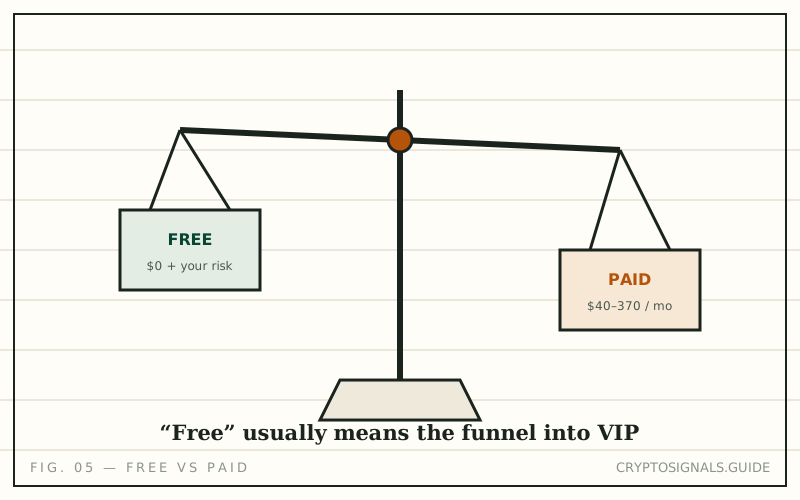
Why free channels exist at all
Start with the money, because it explains the product. A free crypto signals channel earns in three ways, and every design choice follows from which one it uses.
It sells the upgrade. The free feed is a showroom: a few calls a week, the good ones highlighted, a link to VIP under every message. Binance Killers runs a free channel with 233,000-plus subscribers feeding a VIP tier at around $290 a month; Learn2Trade, Fat Pig Signals and Crypto Inner Circle use the same two-tier shape. That isn't dishonest by itself — but the selection bias is real, and the trades you never see skew toward losses.
It earns on your trading fees. Sign up at the exchange through the operator's referral link and they collect a share of what you pay to trade. That incentive rewards trade frequency, not trade quality, which is why some free channels post fifteen calls a day.
It builds an audience worth exploiting. The worst version: accumulate a thin coin, "signal" it to thousands, sell into the spike. Anyone offering "pump access" is telling you which side of that trade you're on — see our scam warning hub.
Free vs paid, side by side
| Free channels | Paid VIP tiers | |
|---|---|---|
| Cost | $0 | ~$40–369/mo as of July 2026 |
| Signal volume | A few per week, selected | Full flow — up to 5–15/day on some services |
| Instrument coverage | Mostly spot majors | Futures, leverage, altcoin setups |
| Losses shown? | Selectively, if at all | Varies — Fat Pig publishes them, most don't |
| Delivery speed | Often delayed behind VIP | First |
| Automation | Rare | Common — bot-parseable formats, API add-ons |
| What they want from you | An upgrade or a referral signup | A renewal |
The arithmetic that decides it
Forget win rates for a moment. A subscription is a fixed cost against a variable return, so the first question is what percentage of your account it eats. Take a mid-market seat at $89 a month — $1,068 a year — and a premium one at roughly $290 a month, or $3,480 a year.
| Account size | Annual return needed to cover $1,068 | … to cover $3,480 |
|---|---|---|
| $1,000 | 106.8% | 348.0% |
| $2,500 | 42.7% | 139.2% |
| $5,000 | 21.4% | 69.6% |
| $10,000 | 10.7% | 34.8% |
| $25,000 | 4.3% | 13.9% |
| $50,000 | 2.1% | 7.0% |
The $2,500 row is where most people in this market actually sit: a 42.7% year just to get back to flat. That's a professional result, demanded of a beginner, to break even. The $25,000 row is a different conversation — 4.3% is a hurdle a decent quarter clears, and the question becomes provider quality rather than affordability.
One line item people forget: the fee compounds your worst outcome. Six months of a losing streak costs the drawdown plus $534, and the sunk-cost feeling is what keeps people paying for a service they've stopped trusting. Set a review date before you subscribe, not during the slump.
When free is strictly better
There are cases where free isn't the budget option — it's simply the right answer:
- You're auditing a provider. Two weeks in the free channel with a spreadsheet tells you more than any review, ours included. Log each call, check the outcome, compare with their published results. The method is in how to vet a signal provider.
- Your account is under $5,000. No subscription clears that hurdle honestly. Free channels plus free tooling — altFINS' free plan, Pionex's built-in bots at 0.05% fees, Bitsgap's free tier — give you structure at zero fixed cost.
- You only trade spot majors. Free feeds cover BTC and the large caps perfectly well. The VIP premium is mostly leveraged futures, which is not where a new trader should be.
- You're learning to read setups. You want fewer calls and more time to study them, not fifteen a day. Start with how to read crypto signals and the free services worth watching.
When a paid seat earns its keep
Paying can be rational. It stops being rational the moment you can't answer four questions with a yes: Is the annual fee under 5% of my capital? Did this provider's accuracy claim survive somebody counting? Will I take half the calls they post? Do I have a date to review the decision?
What money buys, based on the tiers we've subscribed to: volume, speed (VIP gets the call first, and on scalps that matters), futures and leverage coverage, position-management updates, and bot-parseable formatting. What it does not buy is accuracy — the priciest channel in our directory is $369 a month and scores 6.4, while the best-documented one prices in ETH. Prices across every VIP tier are laid out in our paid signals comparison.
Choose free if / choose paid if
Choose free if your account is under about $20,000, you're still building the habit of logging trades, you trade spot rather than leverage, or you haven't yet audited the provider you're considering. Free is also the only sane way to test a channel before wiring money — the shortlist is in our free Telegram channels roundup, and the practical routes are in how to get free crypto signals.
Choose paid if your capital makes the fee a rounding error, the provider has an independently tracked record rather than a screenshot gallery, you have the time and temperament to act on most calls, and you've already run a two-week free audit that matched their published results. Then start from the ranked services rather than from an ad.
Frequently asked questions
Are free crypto signals worth following?
They are worth watching, which is not the same thing. A free channel is a shop window: the calls are real but selected, and the losses are the ones most likely to be quietly missing. Use free access to audit a provider's process for a few weeks before you decide whether the paid tier deserves your money.
Why do crypto channels give signals away for free?
Three reasons. The free channel sells the VIP tier, it earns exchange referral commissions on your trading fees, and in the worst cases it builds an audience large enough to move a thin coin. Nobody runs a free channel for the applause.
At what account size does a paid signal subscription make sense?
Roughly when the annual fee is under 5% of your capital. An $89-a-month seat costs $1,068 a year: that is a 21.4% hurdle on a $5,000 account and 2.1% on $50,000. Below about $20,000, most subscriptions cost more than they can realistically add.
Do paid crypto signals perform better than free ones?
There is no evidence that price predicts accuracy. The most expensive channel we review runs $369 a month; the most transparent one charges in ETH and publishes its losses. Where independent counts exist, advertised win rates fell 10–27 percentage points regardless of what the seat cost.
What do you actually get for a VIP subscription?
Typically more calls per week, futures and leveraged setups rather than spot only, faster delivery, position-management updates, and sometimes bot integration for automated execution. Whether that bundle is worth four figures a year depends entirely on your account size and how many of the calls you can actually take.
Crypto assets are volatile and largely unregulated. Signal services — including every service mentioned on this page — can and do post losing streaks. Never trade with money you cannot afford to lose, and never treat a paid subscription as a guarantee of profit.
We test crypto signal providers with real subscriptions and log every published call — entries, stops and targets — before scoring anyone. Read how we test →