
Disclosure: an educational page — no provider paid to be listed and nothing here is ranked for money. Some review pages we link to carry affiliate links; the policy is spelled out in our testing methodology. One sponsored banner appears mid-article.
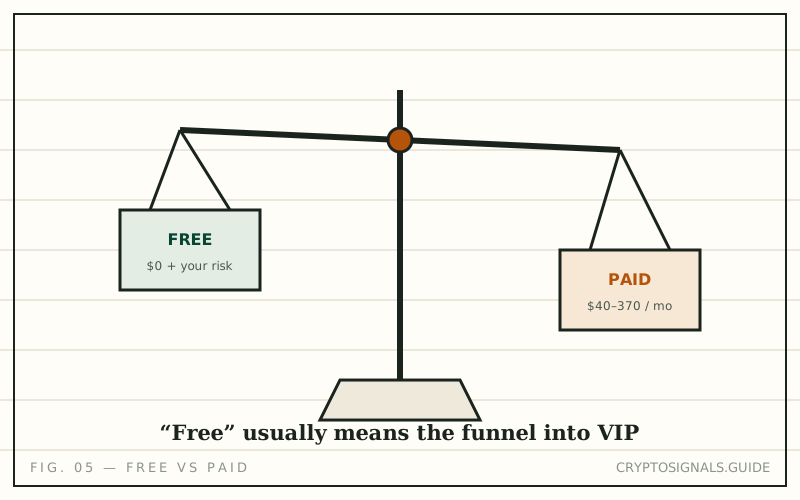
Search "free crypto signals" and you get two kinds of result: channels selling a paid tier, and channels selling you. The gap between those is worth understanding before you join anything, because the free ones with real value all monetize somehow — and the mechanism tells you exactly how much to trust the call.
Five sources are legitimate. Everything else in the free tier is a funnel.
Free tiers of paid channels
Almost every paid provider runs a public channel. It exists to sell the VIP tier, and it works like a shop window: two or three calls a week instead of the VIP's twenty, longer holding periods, spot rather than futures, and — crucially — a curated results feed.
That curation is the catch. Nothing forces a free channel to publish its losers, and plenty don't. Where independent counts exist, tracked accuracy has landed 10 to 27 percentage points below advertised figures; the receipts are in our accuracy tracker.
Used correctly, though, a free tier is the best audit tool you have. You get timestamped, public calls from the same desk that runs the paid room. Log thirty of them before you consider paying for anything. Our ranked shortlist of channels worth auditing this way sits in the free crypto signals guide, and the Telegram-specific ones in free Telegram signal channels.
Exchange copy trading
Major exchanges run copy-trading desks where you mirror a trader's positions automatically. It is not a signal feed — you don't get an entry to evaluate, you get a filled position — but it is free to join and it solves the problem free channels can't: the track record is exchange-verified rather than self-reported.
Read the leaderboard sceptically anyway. Sort by return and you will find accounts with a spectacular three-month curve built on 50x leverage and no visible drawdown control; sort by consistency and the picture changes. Check maximum drawdown, account age and average leverage before mirroring anything, and start at the minimum copy size. Our writeups of Bybit copy trading and Binance copy trading go through the mechanics and the profit-share cut each desk takes.
Free bot tiers on exchanges
Instead of following someone's discretionary call, you can run a rules-based strategy that generates its own entries. Pionex is the clearest example of the model: sixteen built-in bots — grid, DCA and similar — bundled free with the exchange account, with trading fees of 0.05% as of this update.
The honest framing is that this replaces signals rather than supplying them. A grid bot has no opinion about direction; it harvests range. In a trending market it underperforms simply holding, and in a collapse it keeps buying the way down. But it removes the two things that destroy new traders — impulsive entries and no exit plan — and it costs nothing but fees.
Free plans on analytics platforms
Screeners and pattern-detection platforms often keep a permanent free tier as a lead magnet. altFINS runs Free, Essential at $29 a month and Premium at $59 a month as of this update, with pattern-based signals across 3,000-plus assets; the free plan gives you delayed or limited access to the same scans.
What you get is raw material rather than a trade plan: "these fourteen pairs just printed an ascending triangle" is a shortlist, not a call. You still supply the entry, the stop and the size. That is more work than copying a Telegram message and it is also the only version of this that teaches you anything. One caveat worth knowing: platforms in this category frequently publish their own "best signals" rankings placing themselves first, without disclosing the conflict.
Community charting and public ideas
Public charting platforms host tens of thousands of free community indicators and published trade ideas, timestamped and impossible to edit after the fact. That timestamp is the value: unlike a Telegram screenshot, a public idea from three weeks ago still shows what the author actually said before the move.
Filter hard. Sort by author history rather than popularity, ignore anything whose comment section is the author selling a course, and treat scripts with a hundred configurable inputs as what they are — curve fitting with a settings panel. The paid end of this category exists too: LuxAlgo sells indicator suites at $39.99 to $59.99 a month as of this update, which is a reasonable benchmark for what the free community versions are competing with.
Who pays for free: the fee arithmetic
Free channels earn from exchange referral kickbacks — a cut of the trading fees you generate through their link. Their income scales with how often you trade, not how well. Put numbers on it.
Say your average position is $2,000 and your exchange charges 0.1% a side, so $4 per round trip. Trading your own setups, you take 8 trades a month:
- 8 trades × $4 = $32 a month in fees.
Now you join a free channel firing 30 calls a month and you take most of them:
- 30 trades × $4 = $120 a month in fees.
- Difference: $88 a month, or $1,056 a year — paid whether the calls win or lose.
Referral programmes in this niche commonly pay up to 20% of the fees you generate, so the operator collects roughly $24 a month from you. The free channel isn't free; you are paying $88 for it and the operator is keeping a quarter. That is more than most VIP subscriptions cost, which is the uncomfortable part — the trade-off between the two is worked through in our free vs paid signals comparison.
This is not an argument against free channels. It is an argument against taking every call one sends you.
Five guardrails before you follow anything free
- Never pay to enter a "free" group. Activation fees, deposit requirements at a named exchange, or "verify by depositing $200" are not free channels. Walk.
- Refuse anything that asks for keys or funds. No legitimate signal source needs your API keys with withdrawal rights, your seed phrase, or a transfer to a "managed" wallet.
- Check the delete history. Open the channel and scroll back three months. If losing calls are missing and the numbering skips, you are reading marketing.
- Treat urgency as a red flag. "Buy in the next 10 minutes" on a coin you have never heard of is the standard shape of a pump — the mechanics are in our pump-and-dump exposé.
- Watch for clone channels. Popular providers get impersonated constantly, with a near-identical name and a payment address. Confirm the handle from the provider's own site, not from a search result. The full taxonomy is in our crypto signal scams hub.
Then apply the same 30-day paper audit you would apply to a paid room — the process is in how to vet a signal provider. Free changes the price. It does not change the burden of proof.
Free crypto signals: common questions
Where can I get free crypto signals that are worth following?
Five sources hold up: the free tier of an established paid channel, exchange copy trading with a verified track record, free exchange bot tiers such as Pionex, the free plans on analytics platforms like altFINS, and community charting scripts and public ideas. Everything else is usually a funnel or a scam.
Are free crypto signals as good as paid ones?
Usually not in volume or speed — free tiers publish fewer calls, later, and skew toward spot. Quality is a separate question: some free tiers come from the same desk as the paid room. The bigger issue is that free feeds rarely publish their losers, so the visible record is curated.
How do free crypto signal channels make money?
Mainly exchange referral kickbacks, commonly up to 20% of the trading fees you generate, plus upsells to a paid VIP tier. Because the kickback scales with trade count rather than trade quality, a free channel's incentive is to keep you trading frequently.
Is it safe to join a free crypto signals Telegram group?
Joining is low risk. Trouble starts when the group asks for an activation payment, a deposit at a specific exchange, API keys with withdrawal permissions, or a wallet transfer. None of those are ever necessary to receive a trade idea.
Can free trading bots replace a signal subscription?
For range-bound markets and mechanical strategies, often yes. Free grid and DCA bots bundled with an exchange account give you rules-based entries and exits without a monthly fee. They have no directional opinion, so they underperform in strong trends and keep averaging down in a sustained decline.
Crypto assets are volatile and largely unregulated. Signal services — including every service mentioned on this page — can and do post losing streaks. Never trade with money you cannot afford to lose, and never treat a paid subscription as a guarantee of profit.
We test crypto signal providers with real subscriptions and log every published call — entries, stops and targets — before scoring anyone. Read how we test →