
Affiliate disclosure: we have an affiliate relationship with Bitsgap — if you sign up through links on this page we may earn a commission at no extra cost to you. This never affects scores: criteria are fixed in our public testing methodology, and several services we rate higher pay us nothing.
- Platform
- Web app — bot automation via exchange API keys
- Product
- Grid / DCA / COMBO bots + AI assistant
- Pricing (July 2026)
- Free tier · Basic $23/mo · Advanced $55/mo · Pro $119/mo
- Backtesting
- Up to 365 days of historical data
- Exchange coverage
- 17+ exchanges via API
- Win-rate claims
- None — performance depends on your configuration
- Affiliate program
- Yes — 30% commission in USDT (TRC-20), €25 min. payout; we participate
- Risk level
- Market risk remains — automation ≠ profit
Bitsgap earns one of our higher scores by refusing to play the win-rate game at all. It sells infrastructure — grid, DCA and COMBO bots across 17+ exchanges — and hands you a 365-day backtester to audit any strategy before it touches money. That's the accountability model we wish signal channels had. The honest caveat: a backtest is a rehearsal on yesterday's market, and a grid tuned to a range bleeds in a trend. Good tool, real risks, no magic — 7.8/10.
What Bitsgap is
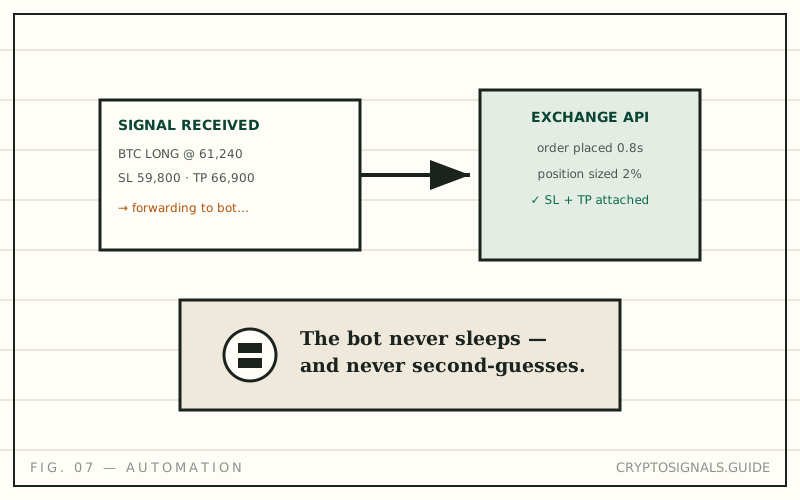
Bitsgap is a web-based trading bot platform, not a signal service. Nobody sends you calls; instead you connect exchange accounts by API key — 17+ venues supported — and deploy automated strategies: grid bots, DCA bots, futures COMBO bots. An AI assistant suggests configurations, and every strategy can be dry-run against up to 365 days of historical data before deployment.
That places it in a different category from the Telegram channels that dominate our review index — closer to 3Commas and Coinrule than to any VIP group. The comparison framework for the whole category is in signals vs copy trading vs bots.
Pricing: four tiers
| Tier | Price (July 2026) | Practical meaning |
|---|---|---|
| Free | $0 | try the interface and basic tools |
| Basic | $23/mo | entry-level bot allocation |
| Advanced | $55/mo | more concurrent bots, wider features |
| Pro | $119/mo | full bot fleet for active accounts |
Do the comparison that matters: $23 a month buys entry to a testable automation platform, while $70–370 a month buys untestable calls from Telegram channels. Even the $119 Pro tier undercuts most premium VIP groups — for software whose behavior you can audit before funding. The fee logic is the same as always (fees are a guaranteed loss the strategy must out-earn), just an order of magnitude friendlier at the entry point.
The bots: Grid, DCA, COMBO
Grid bots ladder buy and sell orders across a price range, harvesting volatility while price chops sideways — the classic range strategy. DCA bots average into positions on a schedule or on dips, smoothing entry price at the cost of catching falling knives slowly. COMBO bots blend grid and DCA logic for futures markets, adding leverage and its consequences. The AI assistant proposes parameter sets — range width, grid density, order size — which beats a blank form, though "AI-suggested" is not "profitable," and the suggestion still deserves a backtest like anything else.
Backtests instead of screenshots
Here's the structural point this review keeps circling. When a Telegram channel says "92% win rate," you can't rerun their claim — you take it or leave it, and our accuracy tracker exists precisely because so few claims survive recounting. A backtest inverts that: you pick the strategy, the pair, the period — up to 365 days — and the platform replays history against your exact configuration. The evidence is generated by you, not curated by marketing.
That's a real epistemic upgrade, and it's why our rubric consistently scores infrastructure above unverifiable channels. But use the tool honestly: one 365-day window is one market regime. Test your grid across a trending year and a choppy year; if you only test the flattering period, you've reinvented the win-rate screenshot with extra steps.
Limits, honest risks and API safety
- Backtests overfit. A configuration tuned until history looks perfect is usually tuned to noise. Prefer robust settings that survive multiple periods over spectacular ones that survive one.
- Grids lose in trends. A grid bot in a sustained downtrend keeps buying a falling asset. Range strategies need ranges; nothing about automation suspends that.
- COMBO bots carry leverage risk. Futures automation can compound losses as mechanically as gains.
- Subscription drag is real. On a $2,000 account, the $55 Advanced tier costs 33% annually — the bot must beat that before profit exists. Size the tier to the account.
- Uptime dependency. Your strategy executes through a third-party platform; platform incidents are part of the risk model.
API safety basics
Bitsgap never holds your coins — it operates your exchange account through API keys you create. Two rules make that arrangement safe: grant trading permission only, never withdrawal permission (the platform can then place orders but can never move funds off-exchange), and use a dedicated sub-account where your exchange supports it, so the bot's playground is fenced off from your main balance. Both take five minutes and remove the worst-case scenario from the table entirely.
Who Bitsgap suits
Strong fit if: you want systematic, rule-based exposure without writing code, you're disciplined enough to backtest across multiple market regimes, and you prefer auditable infrastructure over trusting a stranger's win rate. The free tier makes trying the interface a zero-cost decision.
Wrong tool if: you want someone to tell you what to buy — that's signals, not bots (start with what crypto signals are if you're mapping the territory) — or your account is small enough that even $23/month is meaningful drag, in which case exchange-native bots on venues like Pionex bundle the cost differently.
Where it's strong
- 365-day backtesting — evidence you generate, not marketing
- Grid, DCA and COMBO bots across 17+ exchanges
- Free tier + $23 entry undercuts most VIP channels
- No win-rate theater — the platform makes no performance claims
- API model: it can trade, it can't withdraw
Where it isn't
- Backtests invite overfitting; past ranges don't promise future ones
- Grid strategies bleed in sustained trends
- Futures COMBO bots add leverage risk
- Monthly fee is real drag on small accounts
- Third-party platform uptime is part of your risk
Alternatives worth comparing
- 3Commas — the closest head-to-head: similar bot menu, different pricing and interface trade-offs.
- Coinrule — rule-builder automation with an "if-this-then-that" approach instead of preset bot types.
- Pionex — exchange-native bots with no separate platform subscription.
The full category ranking lives in crypto signal bots, and the strategy-level comparison in signals vs copy trading vs bots.
How we scored it: 7.8/10
Per the methodology: infrastructure platforms are scored on what they let you verify, and Bitsgap's 365-day backtester puts verified-performance potential (35%) directly in the user's hands — the strongest showing available to a tool that makes no claims of its own. Transparency (25%) scores high: published pricing, no win-rate marketing to inflate. Value (15%) is strong from the free tier through $119. Risk practices (15%) get a measured mark — the platform provides testing discipline, but grid-in-trend and leveraged COMBO failure modes are the user's to manage. Net 7.8, near the top of our infrastructure band alongside Cornix.
Bitsgap FAQ
Is Bitsgap legit and safe to connect to an exchange?
It's an established bot platform, not a signal seller — it connects via API keys you create. Standard practice: grant trading permission only, never withdrawal permission, so the platform can place orders but can never move funds off the exchange.
How much does Bitsgap cost?
As of July 2026: a Free tier, Basic at $23/month, Advanced at $55/month, and Pro at $119/month. Higher tiers raise bot counts and unlock more advanced automation.
What bots does Bitsgap offer?
Grid bots that ladder orders across a price range, DCA bots that average into positions, and COMBO bots blending both for futures — plus an AI assistant for configuration and backtesting on up to 365 days of data.
Does a good backtest guarantee future profits?
No. A backtest shows how a configuration would have performed on past data — regimes change, and a grid tuned to last year's range can bleed in this year's trend. Its value is comparative: it filters out obviously bad configurations before real money is at risk.
Is Bitsgap better than following Telegram signals?
Different problems. Signals sell someone else's trade ideas, usually unverifiable; Bitsgap sells infrastructure for running your own systematic strategy, testable before deployment. If unverifiable claims are your frustration with signals, a bot platform addresses the root cause.
Crypto assets are volatile and largely unregulated. Automated strategies — including every bot type Bitsgap offers — can and do post losing streaks, and leveraged COMBO bots can compound losses mechanically. Never trade with money you cannot afford to lose, and never treat software, backtests or subscriptions as a guarantee of profit.
We test crypto signal providers with real subscriptions and log every published call — entries, stops and targets — before scoring anyone. Read how we test →