
Disclosure: educational content — no rankings, no provider placements. One sponsored banner appears below and is labeled. The affiliate rules the whole site runs on are in our testing methodology.
The pipeline in one view
Every signal you'll ever receive travels the same route. Someone or something generates a trade idea. The provider publishes it — to paying subscribers first, everyone else later. You or your bot execute it on an exchange the provider never touches. Finally somebody — ideally not only the provider — tracks what happened. The product feels like prophecy; structurally it's a content business bolted onto a messaging app. Understanding each stage tells you exactly where your results can quietly diverge from the channel's screenshots.
Stage 1: where calls come from
Providers generate calls three ways, in ascending order of automation:
- Human analysis. A trader reads price structure, support and resistance, indicator setups like RSI divergences or MACD crosses, sometimes order-book flow. Strong version: a repeatable playbook applied for years. Weak version: vibes with a chart attached. The indicator logic most of these calls rest on is unpacked in our signal indicators guide.
- Algorithms. Software scans hundreds of pairs for coded conditions — breakouts, momentum thresholds, on-chain movements, social sentiment spikes — and emits alerts, sometimes 100+ per day. Scale impresses; it also mass-produces garbage if the logic was never validated.
- Hybrid. The most common serious setup: screeners surface candidates, a human picks the few worth publishing and writes the levels.
From the outside, all three arrive as the same five-line message. Nothing in the message proves which process — or whether any process — produced it. That proof only exists in tracked results.
Stage 2: publication and delivery
The idea becomes a formatted message: pair, direction, entry, stop, target ladder, leverage. The rigid format isn't tradition — it's an interface. Humans skim it; parsing bots turn it into orders; trackers (like us) log it. Sloppy formatting is why some channels can't be automated or audited, and occasionally that's not an accident.
Delivery runs over Telegram channels (the bulk of the market), Discord servers, app push notifications and web dashboards. The mechanics differ less than the audit trail they leave: Telegram marks edited messages, dashboards can be rewritten silently, screenshots prove nothing. Where a provider chooses to publish tells you something about how comfortable they are being checked.
The latency economics of VIP tiers
Here's the stage beginners never price in: when you receive a call is a product decision. The standard two-tier structure — paid VIP group plus free public channel — is built on time. VIP gets the signal while price still sits in the entry zone. The free channel gets it later: minutes, hours, or "after TP1 hit" as advertising for the paid tier.
Sit with what that implies. A thin-ish altcoin, a channel with tens of thousands of followers, and a staggered release means the free tier's buy orders arrive after VIP is already positioned — free followers literally push price toward VIP's targets. Nobody needs to run a scam for this to happen; it's just queueing. The same logic scaled up, with the operator pre-buying before any signal goes out, is the pump-and-dump machine — the difference is intent and degree, not mechanics.
The defense is mechanical too: check the timestamp against the chart before entering. If price left the entry zone before the message reached you, the trade you'd be taking is not the trade that was published.
Stage 3: execution — hands or bots
Manual: you see the alert, open your exchange, place a limit order in the entry zone, set the stop, ladder the take-profits. Cost: reaction time (scalps can expire while you type), fees, slippage — and the discipline tax, because nothing tests a human like watching a live position.
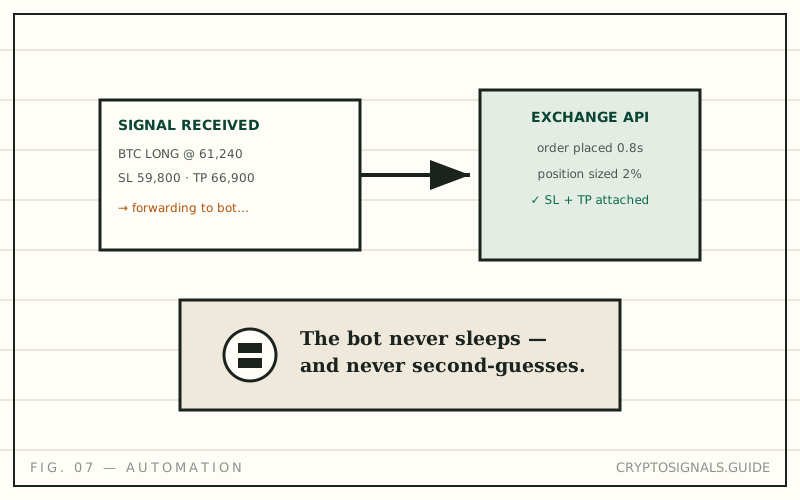
Automated: a bot connects to the channel and your exchange API, parses each call the second it lands and places the full order set with your preset position size and leverage caps. This removes latency and panic from the pipeline — and removes zero risk from the signals themselves. A bot follows a bad call at machine speed. The execution-layer tools and what they cost are compared in our signal bots guide.
Stage 4: tracking, honest and otherwise
The last stage decides whether stages one through three meant anything. Honest tracking logs every published call at publication time and grades it when it resolves — wins, losses, and the unfilled. Dishonest tracking deletes losers, measures wins from the friendly edge of a wide entry zone, and quotes "accuracy" with no denominator.
This stage is where we live: our desk subscribes, logs and publishes the gap between claimed and counted win rates in the accuracy tracker — across the niche that gap runs 10–27 percentage points. If you'd rather generate the evidence yourself, the DIY version is the 30-day audit in how to vet a signal provider.
Worked example: one signal, minute by minute
A hypothetical trace of one call through the whole pipeline, with the arithmetic of delay attached:
- 09:41 — A screener flags BTC/USDT breaking a consolidation at 64,200. The desk's analyst checks the setup, writes levels: long, entry 64,000–64,600, SL 62,700, TPs 66,300 / 67,600 / 70,200.
- 09:52 — Signal posts to the VIP group. BTC trades at 64,350. A VIP follower's bot parses the message and fills at 64,380 within seconds. Risk to stop: 64,380 − 62,700 = 1,680 points.
- 09:57 — Manual VIP subscribers fill around 64,500 after reading the alert and placing orders. Risk: 1,800 points — 7% more than the bot's, same trade.
- 11:30 — The move is underway; BTC touches 65,900. The provider forwards the signal to the free channel. A free follower "enters" at 65,900: their distance to stop is now 3,200 points — nearly double the planned risk — while TP1 sits just 400 points away. Risk one to make an eighth: the published trade no longer exists.
- 14:05 — TP1 at 66,300 fills. The bot follower banks ~1,920 points on the closed half (1.1R); the 09:57 manual entry banks 1R; the free-channel chaser makes 400 points against 3,200 risked (0.125R) and still holds the risk.
- Same evening — The channel posts "TP1 HIT ✅ +3%". Every follower above is inside that statistic. Their outcomes differ by a factor of nine, purely on when and how they entered.
Same signal, same market — the pipeline position did the sorting. That's the working answer to "how do crypto signals work": the message is public, but the edge, if any, is upstream.
Frequently asked questions
How are crypto signals generated?
Three ways: a human analyst reads charts and order flow, an algorithm scans indicators or on-chain data and fires alerts automatically, or a hybrid — software surfaces candidates and a human filters them. The generation method matters less than whether results are tracked honestly.
How are crypto signals sent to subscribers?
Most travel as structured text messages over Telegram or Discord; some services use apps with push notifications or web dashboards. The structured format exists so both humans and automation bots can parse the same message into orders.
Why do VIP members get signals before the free channel?
Because early access is the product. Paying subscribers receive the call while the price is still near the planned entry; the free channel often gets it later — sometimes after the move has started — which quietly turns free followers into demand behind VIP entries.
Does a delayed signal still work?
Usually not as designed. If price has run past the entry zone by the time you see the call, the stop distance and targets no longer match the plan, and the risk-reward the signal was built on is gone. Late entry is one of the main reasons follower results trail channel results.
Can signals be executed automatically?
Yes — automation bots connect to a channel and your exchange API, parse each properly formatted call and place the orders with your preset position size and risk caps. Automation removes reaction delay and panic, but it executes bad signals just as faithfully as good ones.
Crypto assets are volatile and largely unregulated. Signal services — including every service mentioned on this page — can and do post losing streaks. Never trade with money you cannot afford to lose, and never treat a paid subscription as a guarantee of profit.
We test crypto signal providers with real subscriptions and log every published call — entries, stops and targets — before scoring anyone. Read how we test →