
Disclosure: we have no affiliate relationship with CoinCodeCap and earn nothing from this review. Some other links on this page are affiliate links, marked per our disclosure policy. And to state our own structure plainly, since this review is about structures: we sell no signal product of our own — our about page explains how we make money.
- Platform
- Web publication + Telegram signals
- What it is
- Channel reviews since 2017 + own paid signals
- Pricing (July 2026)
- Signals from $99/mo · $499 lifetime (crypto)
- Independent track record
- None found for its own signals
- Affiliate disclosure
- Yes — links are disclosed (credit where due)
- Core conflict
- Reviews its own product's competitors
- Affiliate program
- Yes (we don't use it)
- Risk level
- Moderate — real operation, conflicted structure
CoinCodeCap is a real, durable operation — nine years of publishing is not a rug pull — and it discloses its affiliate links, which puts its hygiene above most of the niche. But the structure is the purest conflict of interest we've reviewed: a ratings site whose every subject competes with its own $99-a-month signal product. Use it as one input among several for research; treat its own unverified signals like any other unverified signals — with a short leash and small size, if at all.
What CoinCodeCap is
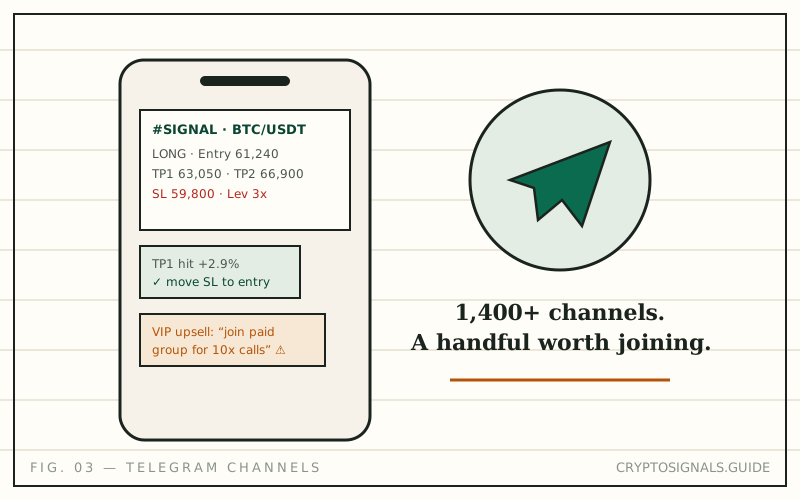
CoinCodeCap started in 2017 as a crypto publication and grew into one of the more-cited review sites for Telegram signal channels. Somewhere along the way it added a second business: its own paid signal service, delivered via Telegram, starting at $99 a month with a $499 lifetime crypto package.
Each half is unremarkable on its own. Review sites are everywhere; $99 signal groups are everywhere. The combination is what makes CoinCodeCap worth a careful review — because when a referee also fields a team, every call it makes deserves a second look.
Pricing of its own signals
| Plan | Price (July 2026) | Note |
|---|---|---|
| Signals, monthly | from $99 | entry tier |
| Crypto signals, lifetime | $499 | ≈ 5 months of monthly at break-even |
The pricing itself is mid-market and sane. $99 a month sits in the fat middle of the niche, and the $499 lifetime breaks even against monthly in about five months. The usual lifetime caveat applies with extra force to a business balancing two revenue models: "lifetime" is a bet on the product's lifetime, and you don't control either variable.
The conflict, drawn precisely — and what it does right
Map the incentives of a review site that sells competing signals:
- Every negative review of a rival is also an ad. If CoinCodeCap rates a channel poorly, the reader's next question is "so what should I use?" — and the house answer is one internal link away.
- Every positive review has a ceiling. Praising a competitor too effectively cannibalizes the in-house product, so the structure quietly pressures rankings to leave room at the top.
- Affiliate revenue tilts the remainder. Where reviews carry affiliate links — disclosed ones, to be fair — the payout table becomes a second, invisible ranking factor.
None of this requires bad faith by any writer. That's the point about structural conflicts: they operate through selection, emphasis and internal linking even when every individual sentence is true. It's the same reason we built our model the opposite way — no in-house signal product, ever — as our about page lays out, and why "who does the reviewer compete with?" is a core check in our trust and scams hub.
Honesty cuts both ways, so credit where it's earned. CoinCodeCap discloses its affiliate links — plainly, on the record. In a niche where most "top 10 signals" pages hide their commissions entirely, that's real hygiene, and it's more than many of the channels it reviews would ever volunteer. Nine years of continuous operation also counts: scams don't usually publish since 2017.
Disclosure narrows the conflict problem; it doesn't dissolve it. Knowing the referee is paid by one team doesn't make the calls neutral — it makes the bias auditable. That's better. It's not the same as independence.
Claimed vs verified performance
For CoinCodeCap's own signal product, we found no independent third-party count of published trades — no external audit, no tracker entry we could cite. So the same sentence we write for anonymous Telegram channels applies to the niche's referee: its win rate is self-reported and unverified. Providers whose numbers survived outside counting are listed in our accuracy tracker; CoinCodeCap Signals is not among them, and at $99 a month you're entitled to ask why a nine-year-old data-savvy publication doesn't publish an auditable log of its own calls.
How to read a competitor's reviews
Practical checklist for using CoinCodeCap — or any conflicted reviewer — as a research source:
- Take facts, skip verdicts. Prices, features, screenshots and histories are checkable; star ratings from a competitor aren't.
- Watch where the internal links point. If criticism of a rival funnels toward the house product, you're reading a sales page with citations.
- Cross-reference the ranking against a non-seller. Compare against sources with no signal product — our best crypto signals ranking exists for exactly this triangulation.
- Check what's missing. Conflicted reviewers rarely publish deep comparisons where the house product loses. Absences are data.
The general version of this skill — auditing whoever is doing the recommending — is step one of vetting any signal provider.
Who CoinCodeCap suits
Useful for: researchers who want a second opinion on a channel's basic facts, or traders comparing feature sets — with the conflict discount applied to every verdict. The publication's longevity means its archive is genuinely deep.
Think twice about: paying $99/month (or $499 upfront) for the house signals on the strength of the house's own site. Unverified performance is unverified performance, whether it's sold by an anonymous channel or a well-known publication.
Where it's strong
- Operating since 2017 — real longevity, deep archive
- Discloses affiliate links — rare hygiene in this niche
- Mid-market pricing, published openly
- Useful factual research base on dozens of channels
Where it isn't
- Reviews its own product's direct competitors — the purest structural conflict we cover
- No independent verification of its own signal performance
- Affiliate revenue adds a second bias layer to rankings
- $499 lifetime bets on a two-model business staying whole
Alternatives worth comparing
- Fat Pig Signals — a provider that answers the verification question directly: public, loss-inclusive record since 2018.
- WolfxSignals — $89/month with an independently tracked 86.44% win rate; cheaper than CoinCodeCap's tier and externally counted.
- AltSignals — the other reviewer-seller hybrid we cover; read the two conflicts side by side.
For non-seller rankings, start from the Telegram signals shortlist or the full best signals ranking.
How we scored it: 5.5/10
Via the methodology: verified performance (35%) scores low — no external count of the house signals exists. Transparency (25%) splits down the middle: genuine credit for disclosed affiliate links and nine years of visible operation, heavy deduction for the undisclosed-in-spirit conflict of rating one's own competitors. Value (15%) is fair at $99 relative to the niche. Risk practices and support are unremarkable. Net 5.5: an established, real operation whose structure — not its conduct — caps how far it can be trusted.
CoinCodeCap FAQ
Is CoinCodeCap legit?
As a publication: real and long-running (since 2017), and it discloses its affiliate links — better hygiene than most of the niche. As a signal seller: performance claims carry no independent verification. The deeper issue is structural — it reviews services that compete with its own paid product.
How much do CoinCodeCap signals cost?
As of July 2026, paid plans start at $99/month, and the in-house crypto signal product is also sold as a $499 lifetime package.
Can I trust CoinCodeCap's reviews of other providers?
Read them knowing the structure: every reviewed provider competes with CoinCodeCap's own $99/month product, and many reviews carry (disclosed) affiliate links. That doesn't make any article wrong — it means you should verify conclusions against sources that don't sell signals.
What is the win rate of CoinCodeCap's own signals?
No independent third-party count exists in our records. Any advertised results are self-reported and unverified.
Is the $499 lifetime package a good deal?
Only if the service outlives your roughly five-month break-even against the $99 monthly plan and keeps performing — neither of which anyone can promise. For unverified signals we recommend the shortest commitment available, or none.
Crypto assets are volatile and largely unregulated. Signal services — including CoinCodeCap's — can and do post losing streaks. Never trade with money you cannot afford to lose, and never treat a paid subscription as a guarantee of profit.
We test crypto signal providers with real subscriptions and log every published call — entries, stops and targets — before scoring anyone. Read how we test →