
Affiliate disclosure: Margin Whales operates an affiliate program and its discount code circulates widely through promoter networks — we are not part of that network and earn nothing from this review. Other links on this page may be affiliate links per our disclosure policy, and never affect the score, which follows our testing methodology.
- Platform
- Telegram
- Focus
- Leveraged trading calls for Bybit and Binance
- Operating since
- 2018
- Pricing (July 2026)
- Not disclosed — advertised only as a 37.5% promo discount
- Claimed win rate
- Not disclosed as a headline figure
- Independently tracked
- Could not verify — no third-party count exists
- Audience
- Not disclosed
- Affiliate program
- Yes
- Risk level
- Moderate — leverage focus, opaque pricing
Margin Whales earns a middling-but-respectable 6.0 on the strength of one thing: it's still here. Eight years of continuous operation in a category where channels routinely disappear after a bad quarter is a real signal about the operator's intentions, and it rules out the exit-scam pattern that defines the bottom of our index. What it doesn't do is prove the calls work — nobody has counted them — and the pricing is deliberately fuzzy, published as a percentage off a number you can't see. Worth a conversation; not worth a blind subscription.
What Margin Whales is
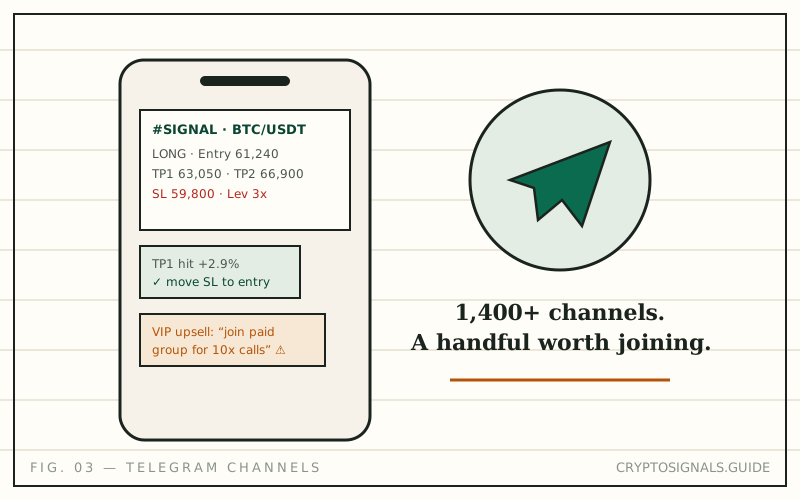
Margin Whales is a Telegram signal channel that has been publishing leveraged trading calls since 2018, aimed at traders using Bybit and Binance. The name is the pitch: margin trading, whale-sized positioning, the whole aesthetic of this corner of crypto.
Beyond that, the public detail is thin. The provider doesn't headline a win rate — unusual, and arguably to its credit given what most channels headline. It also doesn't publish a subscriber count, a trade log, or a plain price. What it publishes is a discount.
Eight years in: what survival actually proves
Set the base rate first. Telegram signal channels are cheap to launch and cheap to abandon. A large share of the ones that were prominent three years ago are gone — renamed after a bad drawdown, quietly deleted, or replaced by a clone with the same avatar. Against that backdrop, running the same brand continuously from 2018 to 2026 is genuinely uncommon, and it rules out several specific failure modes:
- The exit scam. An operator planning to take lifetime payments and vanish does not spend eight years building a name they'd have to abandon.
- The disposable clone. Channels built to impersonate a bigger brand get reported and rotated within months. This one has an identity to protect.
- The one-cycle wonder. A channel that only existed during a bull run never had to explain a bear market to its subscribers. This one did, repeatedly.
Reputation risk is also real for a long-lived brand. An operator with eight years of accumulated goodwill has more to lose from an obvious fraud than a two-month channel does — a weak form of accountability, but not nothing.
Why longevity is not accuracy
Here's where the argument stops. A subscription business survives on renewals and new sign-ups, not on trading outcomes, and those two things are only loosely connected. Consider the arithmetic: if a channel loses 70% of its subscribers every year but keeps buying enough new traffic to replace them, it can run for a decade while never once producing a profitable quarter for the average member. Churn hides everything. The people who left don't post; the people who just joined don't know yet.
So the honest reading of eight years is: the operator is probably not a thief. That's a floor, not a recommendation. What would upgrade it is exactly what's missing — a published, timestamped, loss-inclusive record of those eight years. A channel that has genuinely traded since 2018 is sitting on the most valuable asset in this industry: a long, checkable history. Not publishing it is a choice, and it's the choice that keeps this score at 6.0 instead of the sevens. Our accuracy tracker lists the win rate as unverified, and there are no claimed-versus-tracked figures on this page because neither column exists.
The pricing problem: a discount with no list price
State this plainly, because it's the sort of thing review sites gloss over: Margin Whales does not publish a headline price. What circulates instead is a promo code offering 37.5% off. Thirty-seven and a half percent off what? That's the question the marketing never answers.
| Pricing detail | Status (July 2026) |
|---|---|
| Monthly list price | Not disclosed |
| Quarterly / annual | Not disclosed |
| Advertised offer | 37.5% discount via promo code |
| Renewal price after discount | Could not verify |
Two practical consequences. First, you can't comparison-shop: without a baseline, "37.5% off" could land above or below the $70–150 mid-market and you'd never know until checkout. Second, an undisclosed list price can differ between buyers and between promoter links — the discount becomes a sales device rather than a real reduction. Before paying, get the exact current figure, the billing period, and the renewal rate in writing, and screenshot all three. A provider unwilling to state a price in a message is telling you something about how the renewal conversation will go.
Leveraged calls on Bybit and Binance
The output is margin trading calls targeting the two biggest derivatives venues. That's a sensible choice of exchange — deep books, real liquidation transparency, no obscure platform risk — but leverage changes the maths of everything else on this page.
Work an example. At 10x, a 2% move against you wipes 20% of your margin. Take four such trades in a week, which is entirely normal in a chop, and you're down 80% of the margin allocated to them regardless of what the channel's overall hit rate looks like on a spreadsheet. This is why we keep saying position sizing outranks accuracy: the win rate you bought is a long-run average, while the sequence of losses is what actually closes accounts. Cap risk per trade mechanically, before you look at a single call. The arithmetic is worked through in our guide to using signals, and the broader category context is in futures signals.
Who Margin Whales suits
Reasonable fit: an experienced margin trader who already runs strict sizing rules, wants an additional idea flow on Bybit or Binance, and is comfortable negotiating a price directly rather than reading it off a page. The long operating history means you're unlikely to be dealing with a disappearing act.
Skip it if: you need published pricing before you'll engage, you want a verifiable record, or leverage is new to you. If you're in that last group, read whether crypto signals are profitable and trade spot until sizing is second nature.
Where it's strong
- Continuous operation since 2018 — rare survivorship in this niche
- No exit-scam or vanishing-channel history
- Targets Bybit and Binance rather than obscure venues
- Doesn't advertise a fantasy win rate, unlike most rivals
- A brand with reputation to lose is a weak form of accountability
Where it isn't
- No published list price — only a 37.5% discount off an unknown number
- Eight years of trading history, none of it published as a log
- No independent count; win rate unverified
- Leverage focus concentrates risk in losing streaks
- Subscriber base and team details not disclosed
Alternatives worth comparing
- Fat Pig Signals — also dates to 2018, and actually publishes the record to prove it. The direct comparison is instructive.
- Bybit Copy Trading — leveraged exposure driven by exchange-calculated trader statistics, with no subscription and no price negotiation.
- WolfxSignals — a leveraged channel whose claimed accuracy largely held up under an outside count.
To see the broader leveraged field, start with the futures signals hub or the main signals ranking.
How we scored it: 6.0/10
Our weightings put verified performance first, and there's nothing to score — no audit, no log, no count. Transparency splits: the provider deserves credit for not inventing a win rate, and a mark against it for hiding the price behind a discount code. Value can't be assessed at all when the baseline is undisclosed, so it scores below neutral by default. Risk practices come out reasonably: real exchanges, no pump mechanics, no HYIP compounding promises, no anonymous-lifetime-payment trap. Longevity feeds the risk and trust components, and it's the main reason this lands at 6.0 rather than in the fives — an operator that has kept the same name for eight years has behaved, so far, like one that intends to keep it.
Margin Whales FAQ
What does Margin Whales cost?
We couldn't confirm a list price — the only figure in circulation is a 37.5% promo discount, with no published baseline. Ask for the exact current rate, billing period and renewal price in writing before paying.
Is Margin Whales legit?
Eight years under one name, targeting mainstream exchanges, with no exit-scam or fraud pattern in our research. That's a legitimate operation in the sense that matters most — it just isn't a verified one.
Does running since 2018 mean the signals are good?
No. Channels live on renewals and new sign-ups, not results; heavy churn can hide years of mediocrity. Survival says the operator isn't a thief, nothing more.
What's the Margin Whales win rate?
Unverified. There's no independent count and no public loss-inclusive log, so our tracker carries it without a number rather than repeating a claim.
Should the hidden pricing worry me?
Treat it as a yellow flag. A discount without a list price blocks comparison shopping and lets the baseline vary between buyers. It isn't fraud — but it's a reason to get everything in writing.
What's the main risk in following these calls?
Leverage sequencing. At 10x, four consecutive 2% adverse moves take 80% of the margin behind those trades, whatever the long-run hit rate is. Fix your risk per trade before you read a single signal.
Crypto assets are volatile and largely unregulated. Signal services — including Margin Whales — can and do post losing streaks, and margin trading turns an ordinary streak into a liquidation. Never trade with money you cannot afford to lose, and never treat a paid subscription as a guarantee of profit.
We test crypto signal providers with real subscriptions and log every published call — entries, stops and targets — before scoring anyone. Read how we test →