
Affiliate disclosure: some links on this page are affiliate links — if you sign up through them we may earn a commission at no extra cost to you. This never affects scores: ranking criteria are set out in our testing methodology, and several top-rated services here pay us nothing.
What "live crypto signals" actually means
When people search for live crypto signals today, they're usually picturing a ticker: fresh trade calls scrolling in real time, free, on a webpage. That product cannot exist honestly. A signal's value is its freshness — a real-time call posted publicly for free would be arbitraged dead in seconds, and the poster would be giving away the one thing they sell. So what the industry labels "live" is always one of these:
- A VIP push feed. Telegram or Discord messages to paying members, actionable for minutes to hours. This is the genuine article — and it's paywalled, because of the paragraph above.
- A delayed public echo. The same calls hitting free channels after VIP entries fill. Real signals, expired freshness.
- A dashboard. Logged-in, streaming screeners and alerts (the model altFINS and similar analytics platforms use). Live data, but you make the calls.
- Decoration. A "LIVE" badge over hand-edited content. Common, and disqualifying.
This page is static, so we don't run a fake ticker. What we can give you is better: the map of where real-time delivery actually happens, and the tools to price latency like the cost it is.
Latency economics: why free channels post late
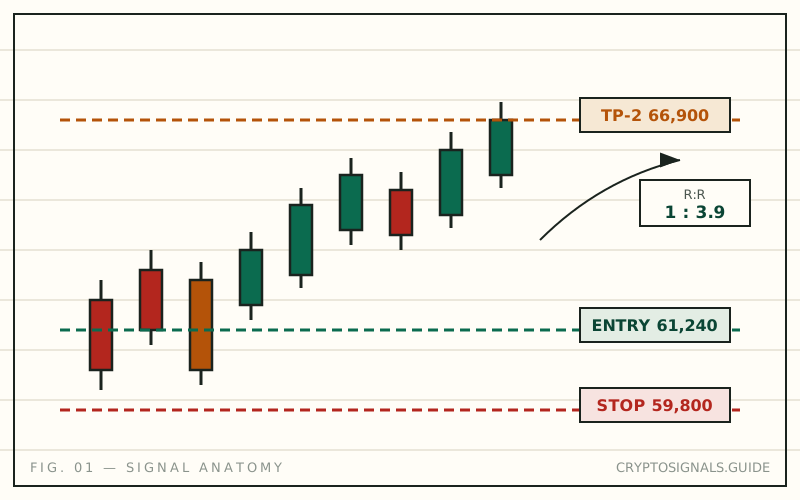
Signal latency isn't an accident — it's the product tier. A provider's paying members must get fills before the crowd arrives, so the free-channel copy of the same call is delayed by design. Run the arithmetic on what that delay costs. A scalp signal says: long BTC, entry $64,200–64,400, target +1.8%, stop −1.2% (illustrative numbers, not a live call). The VIP member enters at $64,300. Fifteen minutes later the free-tier reader sees it — price is already $64,900, nearly at target. Their "same trade" now offers +0.9% upside against the same −2.1% distance to the stop. Identical signal, inverted risk-reward. That's the entire free-vs-paid mechanic in one trade, and it's why we tell readers to audit free tiers rather than trade them — the method is in our free Telegram signals guide.
Daily and swing signals suffer far less: when a setup is meant to play out over days, an hour of latency barely moves the math. If you can't watch markets in real time, matching the signal's cadence to your life beats chasing "live" — which is the honest case for daily crypto signals over real-time ones.
Where genuinely real-time feeds live
Six services we track deliver signals or trades in true real time, each by a different mechanism:
| Service | Real-time mechanism | Price from | Best for | Score |
|---|---|---|---|---|
| Cornix | Bot executes calls the second they publish | $32.99/mo | Removing your own latency from any group | 8.2 |
| Binance Copy Trading | Master's trades replicate to your account instantly | Free | Real-time following without a subscription | 7.6 |
| Bybit Copy Trading | Same-moment trade mirroring, from ~100 USDT | Free | Futures copy with transparent master stats | 7.5 |
| WolfxSignals VIP | Push alerts to paying members | $89/mo | Human calls with a tracked record (86.44%) | 7.4 |
| Universal Crypto Signals | Auto-trade tier executes for you | $91/mo (auto) | Hands-off execution of a channel's calls | 6.3 |
| Signals Blue | API add-on pipes signals to your systems | $229.99 + $49.99/mo API | DIY automation builders (note the 4.9 score) | 4.9 |
Notice the pattern: the reliable real-time mechanisms are execution technologies, not content feeds. The market has quietly answered the "live signals" question with automation — the full comparison is in our signal bot ranking, and the broader field in the top 15.
What a daily signal recap looks like (worked example)
Serious providers publish end-of-day recaps — the habit that makes them auditable. Here's the anatomy of a good one, with hypothetical numbers, clearly labeled as illustration, not trades we or anyone published today:
- Call 1 — BTC long. Posted 09:14 UTC. Entry 64,200–64,400, filled 64,310. TP1 +1.2% hit 11:02, TP2 +2.4% hit 15:47, runner stopped at breakeven. Result: +1.55% average across the ladder, before fees.
- Call 2 — ETH short. Posted 13:30 UTC. Entry 3,180, stop 3,242 (−1.9%). Stopped out 14:55. Result: −1.9%. Posted and kept.
- Call 3 — SOL long. Posted 19:05 UTC. Entry not filled; order expired. Result: no trade — logged anyway.
Three details separate that recap from marketing: the losing trade stays in the log at full size, the unfilled order is recorded (skipping "no trade" days inflates win rates), and every event carries a timestamp you could check against the channel history. When a provider's daily recap shows only green, it isn't a track record — it's a highlight reel. Our accuracy tracker exists precisely because recaps like the honest version above are rare; where third parties counted full histories, claimed win rates fell by 10–27 percentage points. If reading entry ladders and R:R is new to you, how to read crypto signals covers it step by step.
How to evaluate any "live signals" claim
Five tests, thirty seconds each:
- The mechanism test. Push message, executing bot, or API? Real time is physically possible. A webpage with a "LIVE" sticker? It updates when a human edits it.
- The timestamp test. Platform-generated timestamps (Telegram's, not a screenshot of them) that you can scroll back and verify.
- The loser test. Today's recap includes today's losses at full size. No red, no credibility.
- The freshness-pricing test. If truly live calls were free, they'd be worthless by the time you saw them. "Free + live + profitable" — pick two is generous; the real answer is pick one. Anyone claiming all three is running a funnel or worse — see the patterns in our scam-warning hub.
- The cadence test. Does the signal frequency fit your life? A "100 signals a day" feed you check twice daily is noise. For most people with jobs, a slow swing service or copy trading beats any live feed they can't watch.
Frequently asked questions
Where can I see crypto trading signals today, right now?
In the delivery channels of the services above — VIP pushes, copy-trading mirrors, bot executions. Public "today's signals" pages are recycled or decorative by necessity: a genuinely fresh call given away free destroys its own value. Start with the real-time table on this page.
Are there free live crypto signals?
Free and live is the one combination the economics won't allow — free tiers get the delayed echo. The closest honest option is exchange copy trading (Binance, Bybit): no subscription, and the trade mirrors in genuine real time because the mechanism is execution, not content. See our free signals breakdown.
What are daily crypto signals?
Setups issued on a once-a-day-or-slower cadence — swing entries with wider stops and multi-day targets. They tolerate latency, which makes them the rational choice if you can't watch a screen. OnwardBTC's one-signal-per-2–3-days pace in our Telegram ranking is the archetype.
Why doesn't this page show a live signal feed?
Because it can't — honestly. A static page displaying "live" trades would be fabricating them, and fabricated urgency is the first trick of the providers we warn about. We'd rather explain the mechanics and point you at delivery that's verifiably real time.
Do real-time signals perform better than daily ones?
Not for most followers. Real-time scalps decay in minutes, punish manual execution and multiply fees. Where we've compared, a slower signal executed on time beats a fast signal executed late — latency you control matters more than speed you don't.
Crypto assets are volatile and largely unregulated. Signal services — including every service mentioned on this page — can and do post losing streaks. Never trade with money you cannot afford to lose, and never treat any signal feed, live or delayed, as a guarantee of profit.
We test crypto signal providers with real subscriptions and log every published call — entries, stops and targets — before scoring anyone. Read how we test →