
Affiliate disclosure: Signals Blue runs a referral-based access model for its VIP group; we do not participate in it and earn nothing from this provider. Some other links on this page are affiliate links, marked per our disclosure policy. Scores follow our public testing methodology either way.
- Platform
- Telegram + Cornix/API auto-execution add-on
- Focus
- Spot + derivatives signals
- Pricing (July 2026)
- $229.99/mo · $449.99/6mo · $899.99 lifetime
- Automation add-on
- +$49.99/mo for Cornix/API execution
- Independent track record
- None found
- Aggregate user rating
- 2.6/5
- Affiliate program
- Referral-based VIP access model
- Risk level
- Elevated — premium price, unverified results
Signals Blue prices itself in the top bracket of the industry — $229.99 a month, before the $49.99 automation add-on — but we could not find a single independent count of its published trades, and its aggregate user rating sits at 2.6/5 with fresh complaints about vague calls. You'd be paying Rolls-Royce money for a car nobody has been allowed to test-drive. Until a verifiable track record appears, the price-to-proof ratio is among the worst we've scored.
What Signals Blue is
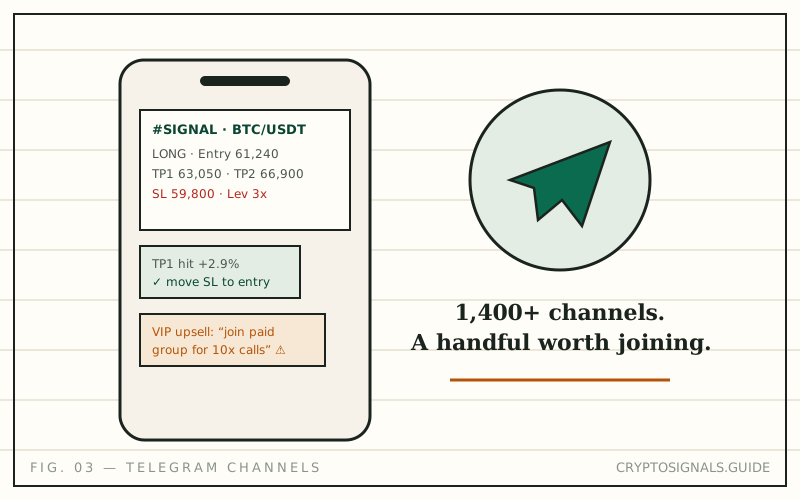
Signals Blue is a Telegram-based crypto signal service covering both spot and derivatives. The pitch is polish: a professional-looking operation, VIP membership tiers, and — the modern differentiator — an automated execution layer that pipes calls straight into your exchange account via Cornix or API for an extra $49.99 a month.
Access to the VIP group runs partly on a referral model, which means some of the people recommending Signals Blue crypto signals online are compensated for the recommendation. That's not a scandal — half the niche works this way — but it should recalibrate how you read the glowing testimonials.
Pricing: the full bill
As of this update, the menu looks like this:
| Plan | Price (July 2026) | Effective monthly |
|---|---|---|
| Monthly | $229.99 | $229.99 |
| 6 months | $449.99 | $75.00 |
| Lifetime | $899.99 | — |
| Auto-execution (Cornix/API) | +$49.99/mo | add-on |
Notice the spread: the monthly plan costs three times the effective monthly rate of the six-month plan. A gap that wide is a pricing strategy, not a discount — it exists to push you into a longer commitment before you've seen a month of live calls. A monthly subscriber who also wants automation is out $279.98 before their first trade fires. For context, that's more per month than most tracked providers in our accuracy tracker charge for a full quarter.
What the signals look like
The calls cover spot positions and leveraged derivatives in the standard actionable format the automation layer requires: pair, entry, targets, stop. That's the theory. The most recent user complaints we found describe the opposite — signals readers found vague, with entries or trade management left open to interpretation.
Vagueness is worse than it sounds, for a mechanical reason: a signal that can be read two ways can be graded two ways. If the entry zone is fuzzy, the provider can count a marginal trade as a win while your fill counts it as a loss. Precise, timestamped, unambiguous calls are the raw material of any honest track record — our guide on how to read crypto signals shows what a fully-specified call looks like.
Claimed vs verified performance
Here's the section where we'd normally put a claimed-versus-tracked bar chart. For Signals Blue, we can't. We found no independent third-party count of its published trades — no audited log, no external tracker, nothing we could set against the marketing. That absence isn't neutral at this price. A $30/month channel with no independent track is unproven; a $229.99/month channel with no independent track is asking you to fund the proof yourself, at premium rates.
Our position is the same one we apply to every provider in the accuracy tracker: performance that can't be independently counted doesn't exist for scoring purposes. If Signals Blue publishes a verifiable, loss-inclusive log, we'll re-score. The vetting checklist we use is public — how to vet a signal provider — and step one is always the same: ask where the losers are recorded.
Complaints and red flags
- 2.6/5 aggregate user rating. Well below the threshold where we can call sentiment "mixed." Paying customers, on average, are not happy.
- Recent "vague signals" complaints. The core product — the call itself — is the thing being criticized, not billing or support.
- Premium pricing with zero external verification. The central mismatch: top-decile prices, bottom-decile proof.
- Referral-based VIP access. Positive reviews may be compensated; discount for that when researching.
- Aggressive plan spread. The 3x gap between monthly and six-month effective rates pressures long commitments before you can evaluate a single month.
What we did not find matters too: no exit-scam history, no fake-giveaway funnels, no "account manager" DM operations of the kind catalogued in our scam warning hub. This is an operating business with an unproven product, not a con.
Who Signals Blue suits
Possibly worth a look if: you specifically want turnkey auto-execution across spot and derivatives, you have the account size where $280/month is a rounding error, and you're prepared to run your own 60–90 day paper-trade audit before risking capital — because nobody else has audited it for you.
Skip it if: you're choosing between this and a tracked provider at a third of the price, your bankroll is small enough that the subscription eats your realistic edge, or the 2.6/5 user rating tells you everything you needed to know. Smaller accounts get more from our free signals ranking plus a disciplined journal than from any $230/month group.
Where it's strong
- Covers both spot and derivatives in one subscription
- Native Cornix/API auto-execution option
- Six-month plan works out to a mid-market $75/mo
- Operating service — no vanishing-act history found
Where it isn't
- No independent track record at any price — let alone this one
- 2.6/5 aggregate user rating
- Fresh complaints about vague, hard-to-act-on signals
- Automation costs extra: $279.98/mo all-in on monthly
- Referral model muddies the water on positive reviews
Alternatives worth comparing
- WolfxSignals — $89/month with one of the smallest claimed-vs-tracked gaps we've recorded (93.37% → 86.44%).
- Fat Pig Signals — the transparency benchmark: a public, loss-inclusive record since 2018.
- MyCryptoParadise — even pricier, but it at least carries a third-party audit to argue about.
For the full field at every price point, start from the best crypto signals ranking or the Telegram channel shortlist.
How we scored it: 4.9/10
Under our methodology, verified performance carries 35% of the score — and with no independent count of Signals Blue's trades, that block scores near the floor. Transparency (25%) fares little better: precise claims are scarce and the recent complaints target signal clarity itself. Pricing/value (15%) is punished hardest of all — the most expensive unverified product we've reviewed this quarter. The automation option and continuous operation salvage points on support/UX. Net: 4.9 — weak trust signals at luxury prices.
Signals Blue FAQ
Is Signals Blue legit?
It's an operating service, not a disappearing act — but its performance claims have no independent verification we could find, and the aggregate user rating sits at 2.6/5 with recent complaints about vague signals. Legit as in real; unproven as in results.
How much does Signals Blue cost?
As of July 2026: $229.99/month, $449.99 for six months, or $899.99 lifetime. Auto-execution via Cornix or API is an extra $49.99/month on any plan.
What is Signals Blue's real win rate?
Unknown. We found no independent third-party count of its published trades, so there's no tracked figure to set against the marketing. At this price point, that absence is the review.
Does Signals Blue work with Cornix auto-trading?
Yes — automated execution through Cornix or API is a paid add-on at $49.99/month. Factor it in: a monthly subscriber paying for automation is at $279.98/month before a single trade.
Why do users complain about vague signals?
Recent complaints describe calls that are hard to act on — unclear entries or management. Vagueness matters doubly, because a signal that can be read two ways can also be graded two ways, which makes independent tracking nearly impossible.
Crypto assets are volatile and largely unregulated. Signal services — including Signals Blue — can and do post losing streaks, and derivatives positions can be liquidated entirely. Never trade with money you cannot afford to lose, and never treat a paid subscription as a guarantee of profit.
We test crypto signal providers with real subscriptions and log every published call — entries, stops and targets — before scoring anyone. Read how we test →