
Affiliate disclosure: we participate in Margex's referral program, which pays up to 40% of referred trading commissions — so we earn if you sign up through links here. It changes nothing about the score: our criteria are fixed in the public testing methodology, and this page spends most of its length on what we could not verify. Full policy in our disclosure statement.
- Platform
- Crypto exchange — web, derivatives + copy trading
- Focus
- Alerts on 70+ assets, AI sentiment, copy trading from 100+ traders
- Pricing (July 2026)
- No signal subscription — trading fees only: 0.019% maker / 0.060% taker
- Signal type
- Exchange-native alerts and sentiment scores, not a call feed
- Win-rate claims
- None published for the alert tools; copy-trader stats are self-reported by the platform
- Independently tracked
- Nothing — no third-party record exists for us to check
- Affiliate program
- Yes — up to 40% of referral commissions ($346k monthly payouts per the company's own figures); we participate
- Risk level
- Elevated — leveraged products, unverified tooling
Margex is the answer to a question most signal buyers never ask: what if the alerts were free and you just paid to trade? For an active account that maths out cheaper than any VIP group we've priced. The catch is that "included" is not the same as "proven" — nothing in the alert stack has an independent track record, and the company runs its own signal-provider rankings while paying some of the fattest referral commissions in the sector. A solid, useful venue with a conflict you should hold in view: 7.0/10.
What Margex actually is
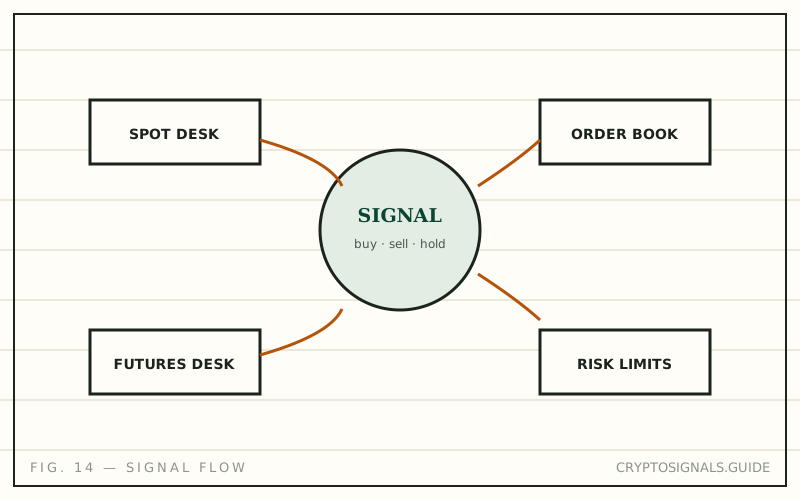
Strip the marketing and Margex is a derivatives exchange that has absorbed three things people normally buy separately. Price alerts across 70+ assets. An AI sentiment read on those assets. Copy trading from a roster of 100+ traders. None of it sits behind a monthly paywall — it comes with an account, funded by the spread between what you trade and what you're charged for trading it.
That places Margex in an odd bracket for a site like ours. It is not a signal provider in the sense that Binance Killers is, and it is not a bot platform in the sense that Bitsgap is. It's the venue that ate both jobs, which is exactly why it's worth pricing against them.
The price is the fee schedule
There is no plan table to compare because there are no plans. As of this update the entire cost of the "signal" side of Margex is the cost of trading:
| What you pay for | Cost (July 2026) | What it means in practice |
|---|---|---|
| Signal subscription | $0 | alerts, sentiment and copy trading come with the account |
| Maker fee | 0.019% | you add liquidity with a resting limit order |
| Taker fee | 0.060% | you hit the book with a market order |
Run the arithmetic that actually decides this. A $10,000 position opened and closed as a taker costs $6 each way — $12 the round trip. A mid-market VIP group at $150/month costs the same as 12.5 of those round trips before it has produced a single winning call. If you trade fewer than roughly a dozen five-figure positions a month, the bundled model is cheaper. If you scalp all day, the fee line eventually overtakes any subscription, and you should be counting it the way we count it in whether signals are profitable after costs.
One thing the zero-subscription model does not remove: fees are still a guaranteed loss your strategy must out-earn. Free tooling attached to expensive churn is not free.
The alert stack and copy trading
The alerts are threshold-and-condition tooling across 70+ assets — you're told when something moves, not what to do about it. That distinction matters. A Telegram call gives you entry, stop and targets, right or wrong; an alert gives you attention. Traders who already have a plan get value from the first. Traders who want to be told what to buy will find the alert stack strangely empty, and should read how to read a signal before assuming the two are interchangeable.
The AI sentiment layer scores assets from market chatter. Treat it as one input among several: sentiment data is genuinely useful for spotting crowding, and genuinely terrible as a standalone trigger — the failure modes are the same ones we lay out in the LunarCrush review, where sentiment is the whole product.
Copy trading is the piece closest to a signal subscription. You pick from 100+ traders, allocate, and their positions mirror into your account. It is structurally more honest than a VIP group — you see a recorded history before committing and you exit by clicking stop — but the history is recorded and displayed by the party that profits from your volume. Leaders who blew up quietly stop appearing in the list.
What we could not verify
We have no independent track record for anything Margex offers. No third party has logged its alert outputs; the copy-trading statistics are platform-reported; and the company publishes no audited win rate for the AI layer. That is why Margex appears nowhere in our claimed-versus-tracked table — there is no claim to test and no tracked series to test it against.
To be clear about direction: this is an absence of evidence, not evidence of a problem. Margex isn't advertising a 96% win rate that collapses under counting, which is the failure pattern that sinks scores elsewhere in our review index. An exchange making no performance claim is behaving more honestly than a channel making an unverifiable one. It just can't earn verification points it never competed for.
Margex reviews signal providers too
Here is the part most reviews of Margex leave out. Margex publishes its own editorial content ranking the best signal providers. That content is produced by a company that earns money when a reader opens a trading account — the same structural conflict we spend half this site warning about, sitting inside a service we're reviewing.
It doesn't make their list worthless. It does mean the list is marketing with footnotes, and should be read as a competitor's pitch rather than as research. Apply the same test we invite readers to apply to us: does the publisher show its scoring weights, does it name what it couldn't verify, and does it ever rate a paying partner below a non-paying one? Our answers are in the methodology and in how to vet a signal provider.
And for the avoidance of doubt: we take up to 40% of referred commissions from this provider. That number appears in the scorecard above precisely so you can weigh it against the 7.0.
Who Margex suits
Good fit if: you trade actively, you already have a strategy and want alerting plus sentiment context bundled into the venue rather than billed monthly, and you'd rather allocate to a copy-trading leader you can switch off than pay upfront for calls you can't audit.
Wrong fit if: you want someone to hand you entries and stops — the alert stack doesn't do that — or you're new enough to leverage that a bundled derivatives account is a hazard rather than a saving. Beginners are better served starting at crypto signals for beginners and staying on spot.
Where it's strong
- No signal subscription at all — fees only, 0.019% maker / 0.060% taker
- Alerts across 70+ assets bundled with the trading account
- Copy trading you can stop with a click, not a cancellation
- Makes no inflated win-rate claim of its own
- Cheaper than a mid-market VIP group at realistic trade volumes
Where it isn't
- Zero independent verification of alerts or copy-trader results
- Copy-trading stats are reported by the platform that profits from them
- Alerts flag movement — they don't give entry, stop and targets
- Publishes its own signal-provider rankings while paying referral fees
- Leveraged products make the "free tooling" account a high-risk one
Alternatives worth comparing
- Bybit Copy Trading — deeper leader pool and longer visible histories for the same copy-trading job.
- Binance Copy Trading — the liquidity heavyweight; slower to switch leaders, harder to fault on depth.
- Pionex — the other no-subscription route: 16 exchange-native bots instead of alerts and leaders.
For the structural choice underneath all of this, read signals vs copy trading vs bots, or browse venue-by-venue coverage in crypto signals by exchange.
How we scored it: 7.0/10
Applying the standard weights: verified performance (35%) scores in the middle, not the basement — there is nothing tracked to credit, but also nothing inflated to punish, and an exchange that declines to publish a fake win rate keeps the points a channel would lose. Transparency (25%) is mixed: fees are published to three decimals, while copy-trader statistics are self-reported and the company's own provider rankings are a disclosed-nowhere conflict. Pricing and value (15%) is the strongest card by far. Risk practices (15%) sit at amber for leverage. Support and UX (10%) are unremarkable in both directions. That lands at 7.0 — above the unverifiable-channel median, below the infrastructure names that let you test before you fund.
Margex FAQ
Does Margex charge for signals or alerts?
No separate subscription as of July 2026. Alerts across 70+ assets, the AI sentiment tooling and copy trading come with the account; you pay trading fees instead — 0.019% maker, 0.060% taker. The cost is real, it just scales with your volume rather than the calendar.
Is Margex legit?
It is a functioning exchange with a working product, not a vanishing Telegram group. What we cannot do is verify the performance of its alerts or copy-trading leaders against our own logs, so treat those as untested tooling rather than proven edge.
What is Margex's real win rate?
There isn't one to quote. Margex does not publish an audited win rate for its alerts, and we have no independently tracked figure for it — which is why it appears nowhere in our accuracy tracker. Any percentage you see attached to its copy traders is self-reported platform data.
Why do you mention that Margex publishes its own signal rankings?
Because a company that earns money when you open an account is not a neutral judge of which signal provider you should follow. That applies to Margex's "top providers" content and, in fairness, to any affiliate-funded site — including this one. Our defence is a published methodology and scores that don't move for money.
How much does Margex pay affiliates, and does that affect this score?
Up to 40% of referral trading commissions, with monthly payouts published by the company at around $346,000. We take part in that program and are telling you so. The 7.0 comes from the same rubric applied to every provider; several services we score higher pay us nothing.
Is copy trading on Margex better than paying for a VIP group?
Structurally, yes: you see a leader's platform-recorded results before you allocate, and you stop by clicking stop rather than by cancelling a subscription. But platform stats are curated by the platform, survivorship bias is brutal, and copying leverage is still leverage.
Crypto assets are volatile and largely unregulated. Leveraged trading on any exchange, including Margex, can liquidate a position in minutes, and copy trading inherits every risk the copied trader takes. Never trade with money you cannot afford to lose, and never treat a built-in alert or an AI sentiment score as a guarantee of profit.
We test crypto signal providers with real subscriptions and log every published call — entries, stops and targets — before scoring anyone. Read how we test →